

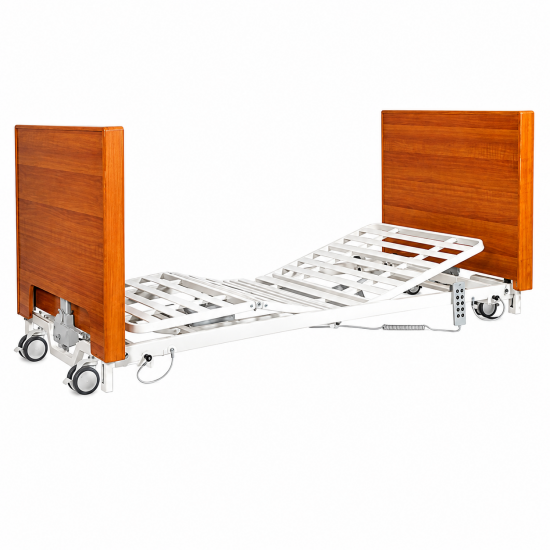
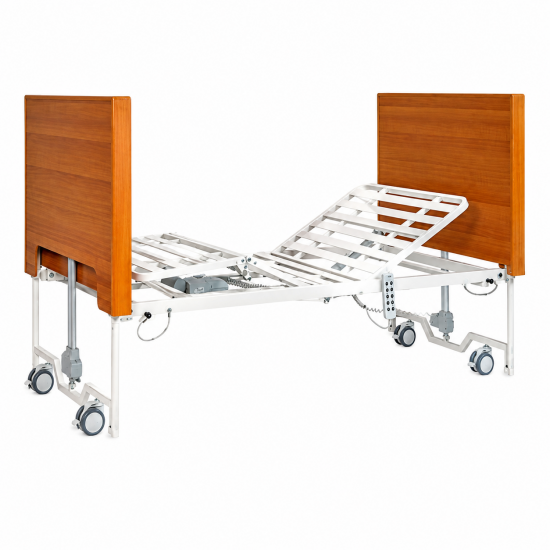
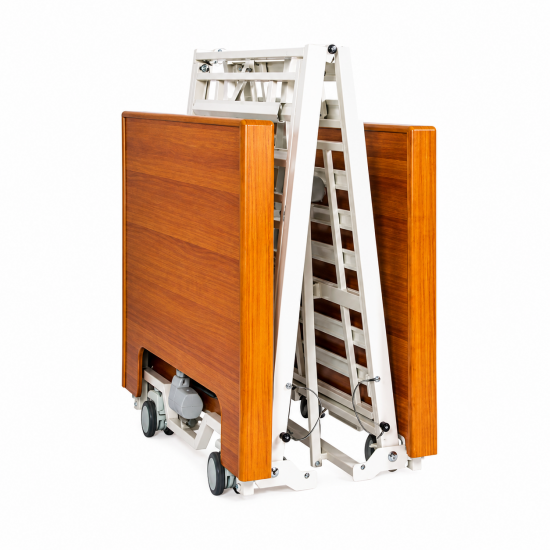
A Foldable Electric Care Bed Designed to Use Space More Efficiently
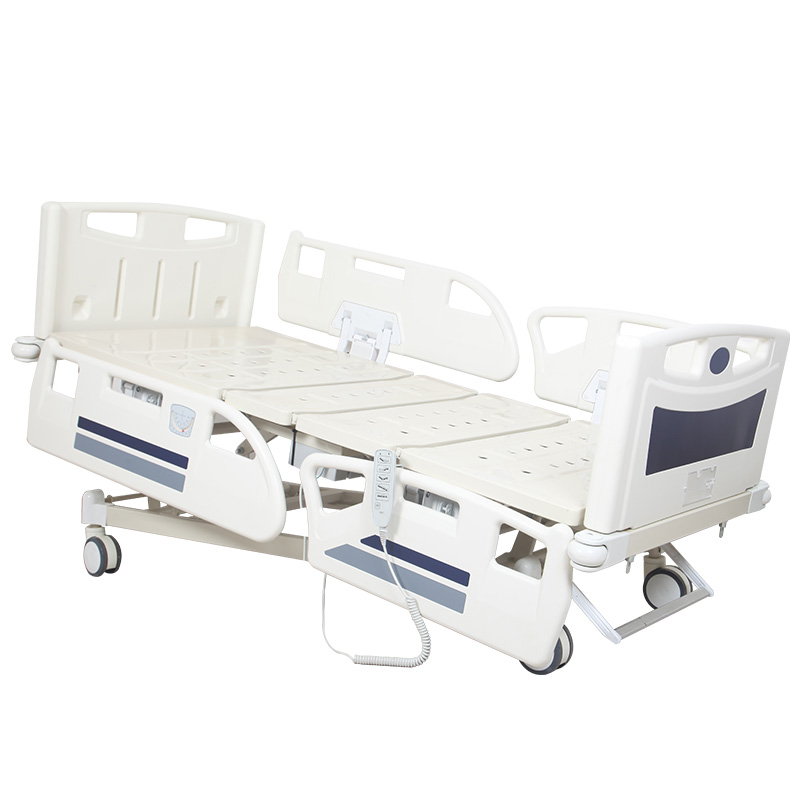
Care beds are normally evaluated by their positioning functions, but storage footprint can also be an important consideration for distributors, rental companies and care facilities managing multiple units. This electric care bed combines a compact foldable frame with an ultra-low 100–500 mm vertical lifting system, creating a practical solution for both everyday care and equipment management.
When in service, the bed provides powered backrest adjustment, knee positioning, height adjustment, Trendelenburg and reverse Trendelenburg functions. When the bed is temporarily out of use, its frame can be folded into a much more compact configuration for storage and handling.
From 100 mm Ultra-Low to 500 mm Care Height
Wide Height Range for Different Stages of Daily Care
The sleeping platform offers an approximate height adjustment range of 100–500 mm. Instead of limiting the bed to a conventional fixed nursing height, this wide range allows the platform to be positioned according to different care situations.
100 mm Minimum Platform Height
At its lowest position, the mattress platform is approximately 100 mm above floor level. This ultra-low configuration is particularly useful in elderly and long-term care environments where reducing the height of a possible bedside fall is an important consideration.
Raised Position for Caregiver Access
When personal care, bedding changes or other bedside activities are required, the platform can be raised electrically to approximately 500 mm. Caregivers can therefore change the working height without manually lifting the bed structure.
Vertical Hi-Low Movement with Minimal Horizontal Displacement
Near-Straight Up-and-Down Adjustment
A key engineering feature of this model is the way the complete platform changes height. The lifting mechanism is designed to move the bed in a near-straight vertical path between its low and raised positions.
This differs from mechanisms that create substantial longitudinal movement as the platform rises or lowers. By minimizing horizontal displacement, the vertical lift design can be advantageous when the bed is positioned near a wall, bedside cabinet or other room furniture.
Useful Where Room Layout Is Limited
For nursing homes and residential care rooms where available space must be carefully planned, predictable vertical movement can make positioning the bed within the room more straightforward.
Buyers comparing models within the Nursing Bed range should therefore consider not only minimum and maximum height, but also how the bed moves between those two positions.
Five Powered Adjustments for Flexible Positioning
Backrest Elevation from 0° to 75° ±5°
The electric back section can be adjusted from a flat position to approximately 75 degrees. This allows the upper body to be raised progressively for sitting, eating, reading, communication and routine personal care.
Knee Rest Adjustment from 0° to 40° ±5°
The knee section provides approximately 0–40 degrees of powered adjustment. It can be used separately or together with backrest elevation to create different supported resting positions.
Electric Whole-Bed Height Adjustment
The complete sleeping platform moves between approximately 100 and 500 mm. Powered operation makes it possible to switch between an ultra-low resting position and a higher working position using the handset.
Trendelenburg Adjustment
The platform provides approximately 0–12° ±2° of Trendelenburg adjustment, allowing the complete bed surface to be tilted as required by the care provider.
Reverse Trendelenburg Adjustment
The bed can also tilt in the opposite direction through approximately 0–12° ±2°. Together with the articulated back and knee sections, this gives caregivers a broader selection of positioning configurations.
Fold the Bed When Full-Size Storage Is Not Practical
Compact Folding Structure
Unlike a conventional nursing bed that permanently occupies its complete assembled footprint, this model incorporates a foldable structural design. The frame can be brought into a compact upright configuration when the bed is not in active use.
More Efficient Warehouse Storage
This is particularly relevant to distributors and importers that may keep multiple units in inventory. Reducing the footprint of each stored bed can help make better use of available warehouse space.
Practical for Care Equipment Rental Fleets
Rental operators frequently have equipment returning to storage between users. A foldable bed can be easier to organize in facilities where a number of beds need to be stored temporarily before their next deployment.
Useful for Facilities with Reserve Beds
Nursing homes and care institutions may also maintain spare beds for changes in occupancy. The compact configuration provides a practical alternative to leaving every reserve bed fully extended while it is not in service.
Residential Wood-Finish Design for Elderly Care
Less Institutional Visual Appearance
The bed uses large wood-finish head and foot panels rather than relying entirely on conventional hospital-style plastic panels. The warmer exterior helps reduce the clinical appearance of the equipment and allows it to fit more naturally into long-term residential environments.
This makes the design particularly appropriate for elderly care centers, nursing facilities, assisted living environments and other settings where the bed becomes part of the resident's everyday living space.
Structural Details for Repeated Daily Operation
Epoxy-Coated Steel Frame
The main supporting structure is manufactured from epoxy-coated steel. The metal framework provides the structural foundation required for repeated powered positioning and height adjustment.
Steel Sleeping Platform
The articulated platform is also based on epoxy-coated steel construction and is divided into adjustable sections corresponding to the bed's powered positioning functions.
Four Electric Actuators
The bed is equipped with four electric actuators to operate its powered adjustments. A wired handset provides centralized control of the available positioning movements.
Four Double-Sided Casters
Four double-sided casters support bed mobility. Each caster is equipped with an independent braking mechanism so that the bed can be secured after it has been moved into the required position.
Who Is This Electric Care Bed Designed For?
Nursing Homes and Elderly Care Facilities
The combination of ultra-low positioning, adjustable care height and a residential-style exterior makes the bed well suited to environments providing long-term support for older residents.
Assisted Living and Residential Care
Where buyers want care functionality without introducing an overly clinical appearance into resident rooms, the wood-finish exterior provides a more home-oriented alternative.
Medical Equipment Distributors
For distributors, the product offers several clear selling points beyond standard electric adjustment: 100 mm minimum height, vertical lifting and a foldable storage structure.
Care Bed Rental Providers
The ability to fold the frame can be especially useful for companies that repeatedly deploy, recover and store care beds as part of a rental fleet.
What Makes This Model Different from a Conventional Electric Nursing Bed?
A standard electric nursing bed may already provide backrest, leg and height adjustment. This model is intended for applications where buyers require additional differentiation in both low-height capability and equipment storage.
The sleeping platform descends to approximately 100 mm, substantially changing how low the resident can be positioned. It then rises vertically to approximately 500 mm when a higher care position is needed.
The foldable structure addresses another issue that is often overlooked during product selection: what happens to the bed when it is not being used. For distributors, rental providers and institutions holding reserve equipment, storage efficiency can influence the practical cost of managing a fleet of care beds.
Low for Rest, Raised for Care, Folded for Storage
The design of this electric care bed can be summarized through three operating states. It can be lowered to approximately 100 mm when an ultra-low resting position is required, vertically raised to approximately 500 mm for easier caregiver access, and folded into a compact configuration when the complete bed is no longer required in the room.
Combined with powered backrest, knee-rest, Trendelenburg and reverse Trendelenburg adjustments, these characteristics make it a distinctive option within our Nursing Bed range for long-term care projects and professional equipment procurement.
For specifications, OEM configurations, distributor orders or project purchasing, please contact us with your required quantity and application.