

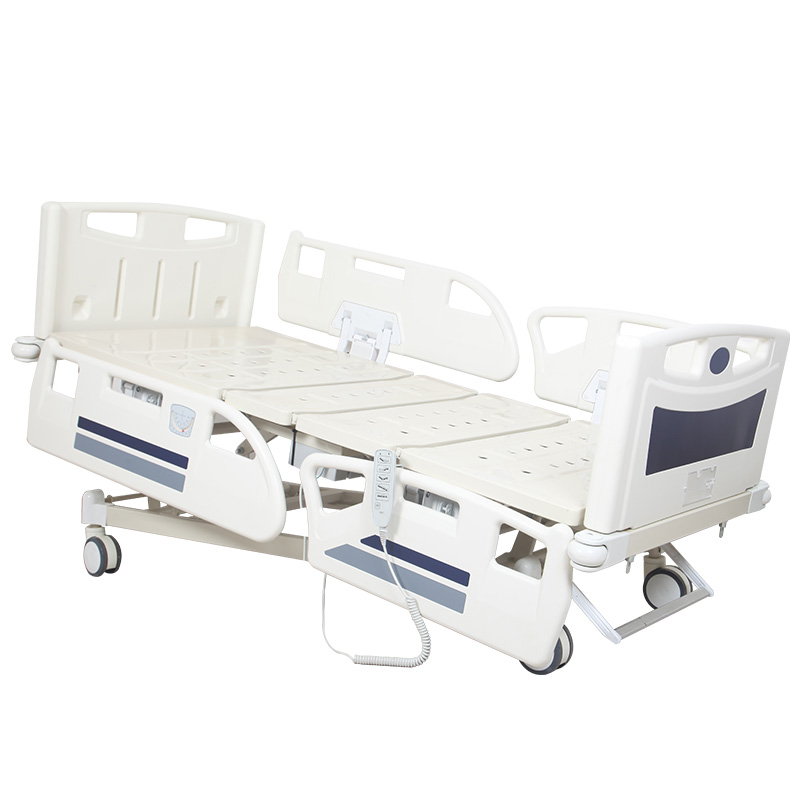
A height adjustable electric hospital bed allows the complete mattress platform to move vertically through a powered lifting system. Unlike backrest or leg adjustment, which changes the patient's body position, height adjustment changes the working level of the entire bed. This function can benefit both patients and caregivers. A lower position may support selected transfers or easier bed-edge sitting, while a higher position can provide nurses and caregivers with a more practical working height during dressing, cleaning, bedding changes and routine patient care. However, simply stating that a bed is “height adjustable” does not tell a buyer whether the lifting system is well designed. Hospital buyers should also evaluate the actual minimum and maximum height, lifting geometry, platform stability, actuator configuration, synchronization, mattress-top height, caster clearance and the way electrical cables move throughout the full lifting range. Different height adjustable electric hospital bed models can be compared according to ward requirements, patient mobility and required working height. A height-adjustable electric bed uses powered actuators to raise or lower the complete sleeping platform. The user or caregiver normally controls this movement through a handset or control panel. Depending on the model, the bed may also provide: Height adjustment is therefore one function within the complete electric bed system, but it has its own mechanical requirements. Backrest adjustment moves only the upper section beneath the patient's torso. Height adjustment moves the entire mattress platform, including: This means the lifting structure carries a substantial load every time the bed rises or lowers. The value of height adjustment usually comes from changing the relationship between the patient, caregiver and surrounding equipment. A lower bed can make it easier for suitable patients to place their feet closer to the floor when sitting at the edge of the mattress. A higher platform can reduce the amount of bending required during routine bedside care. In selected situations, changing bed height can help align the mattress surface more closely with another transfer surface. Buyers often focus on the lowest position because lower beds appear more accessible. But the maximum height is equally important. A very low bed with a limited upper range may still be inconvenient for daily nursing. The exact range depends on the product structure. Selected electric hospital beds may provide an approximate platform-height range such as 400–700 mm, while other models may be higher, lower or use different dimensions. The exact minimum and maximum values should always be confirmed from the technical specification of the selected model. The phrase “bed height” can be ambiguous. Some suppliers refer to the steel mattress platform. Others may refer to the top of the mattress. This prevents incorrect comparisons between quotations. If the platform is 400 mm above the floor and an 80 mm mattress is installed, the actual sleeping surface is higher than 400 mm. This matters for: A hospital bed is used by many different patients and caregivers. One fixed working level cannot be ideal for every situation. The useful specification is therefore the complete vertical range. The actuator system transfers electrical power into movement of the lifting frame. Depending on the bed design, vertical adjustment may use: The exact architecture varies between manufacturers and models. The actuator creates force, but the lifting geometry determines how that force is transferred to the bed. This is why motor specifications alone cannot describe the performance of the height-adjustment system. A well-designed lifting mechanism should move the platform vertically in a controlled way without excessive side movement. One of the most important things to observe is whether the mattress platform remains level throughout normal height adjustment. If one side or one end rises noticeably faster than another, the user may feel unnecessary movement and the structure may experience uneven loading. These two movements are sometimes confused. Moves the entire platform upward or downward while keeping it generally level. Tilts the complete mattress platform so the head and foot ends are at different heights. A bed can provide electric height adjustment without providing Trendelenburg. Higher-function electric beds may use coordinated movement between lifting components. When both ends move together, the platform changes height. When the relative positions differ, the bed can create whole-platform tilt on models designed for this function. The exact control logic depends on the product. If multiple actuators or coordinated lifting systems are involved, their movement needs to remain properly controlled. A good electric lifting movement should feel controlled rather than abrupt. Hospitals may naturally assume faster lifting means higher performance. In patient-care equipment, smooth and predictable movement can be more important than maximum speed. A bed that starts and stops gently can provide a more controlled experience. A bed is usually easiest to stabilize when it is in its lowest position. The more revealing test is often the highest position. As the platform rises, the patient's center of mass also moves higher. This naturally makes frame geometry and caster position more important. The lifting structure therefore needs to provide sufficient support throughout its range. The electric lift mechanism is mounted to the main steel structure. Depending on the bed model, hospital beds may use rectangular steel tubes around 80 × 40 mm with different wall thicknesses. However, tube size alone does not determine performance. Every height cycle moves the lifting arms around pivot points. These joints may operate thousands of times during the life of the bed. If lifting joints become excessively loose, the platform may feel less stable at higher positions. This is why buyers should not inspect only the motor system. The mechanical lifting components are equally important. The motor system must move the bed while supporting the patient, mattress and normal accessories. Depending on the model, robust electric hospital beds may provide rated capacities around 250–260 kg or more. The actual value should be confirmed for the exact bed. Buyers should not assume actuator capacity alone equals the complete bed's safe working load. Electric hospital-bed actuators may be available with protection levels such as IPX4, with higher levels such as IPX5 available on selected configurations. The exact motor protection specification should be confirmed for the supplied system. A recognized actuator brand can be valuable, but the complete installation still determines performance. Vertical lifting generally moves more total mass than a simple backrest adjustment. The electrical system therefore needs to support the intended operation correctly. An electric bed changes its geometry as it rises and lowers. Electrical cables need enough controlled movement to follow the structure. Cables should not become trapped between moving components. Cables should not become excessively stretched. They should remain clear of pivots, casters and lifting arms. Too little slack can place tension on connectors. Too much uncontrolled slack can leave cables hanging near moving mechanisms. The best routing provides enough movement without unnecessary loose loops. The lifting system occupies space beneath the mattress platform. As the bed changes height, the relationship between these components and the floor also changes. It influences: Changing the mattress-top height may help align the bed more closely with another support surface. However, the platform height alone is not enough. Two electric beds may have similar platform ranges but use different mattresses. The patient's actual position can therefore differ. When transfer matching is important, evaluate the complete bed-and-mattress system. Bedside tasks may require caregivers to work close to the mattress for extended periods. Raising the platform can provide a more suitable working level. Caregivers vary in height, and different tasks require different positions. This is why adjustability is more useful than selecting one “ideal” fixed bed height. Not usually as a general rule. The working height can be raised for care and then adjusted according to the intended patient-use condition. The appropriate position depends on patient mobility, care procedures and facility protocols. For suitable patients, a lower mattress-top height can support easier bed-edge sitting. The patient may be able to place both feet more securely on the floor. However, mattress thickness and patient body proportions need to be considered. Standard electric hospital beds may have a relatively low minimum height, but specialized ultra-low care beds use a different design priority. Buyers should distinguish between: A hospital bed may prioritize caregiver working range and clinical workflow. An elderly-care bed may place greater emphasis on achieving an especially low minimum sleeping height. Product names alone should therefore not replace actual dimension checks. The side rails move vertically together with the mattress platform because they are connected to the bed structure. The relationship between the mattress and rails remains more important than the relationship between rails and floor. The rail height relative to the mattress normally remains the same during vertical adjustment. However, overall bed stability at a higher platform position becomes more important. This is another reason to inspect the complete bed at maximum height. Higher-level electric models may use four-piece ABS rails. The rail structure should remain stable throughout bed movement. Electric beds designed for general wards may use folding aluminum alloy rails. The most appropriate rail type depends on the target product level rather than the height function alone. The bed rests on its casters at every height. The distance and geometry between the wheels influence how stable the bed feels as the platform rises. Both systems can be used on height-adjustable electric beds. Each caster is locked separately. Multiple wheels can be controlled through a coordinated mechanism. The choice depends on how frequently staff move the bed. A raised platform increases the importance of stable bed positioning. Buyers should confirm that the bed remains secure and that the caster mounting structure does not create excessive movement. On a five-function bed, both systems may use related lifting structures. Sample evaluation should confirm: Each movement should be smooth and predictable. After whole-bed tilt, the platform should return to an appropriate level position according to the bed design. Visible misalignment may indicate mechanical or synchronization issues that deserve inspection. Many three-function models use: For general wards, this can provide a practical combination because it includes the main patient-positioning movements plus caregiver height adjustment. A manual two-function or fixed-height bed may already provide back and leg positioning. Adding electric vertical movement changes how staff interact with the bed throughout the day. This is why buyers should evaluate the height system as its own product feature. It provides the most value when: A simpler configuration may be appropriate when: Two beds may use different actuator architectures while achieving a similar vertical movement. The useful comparison should focus on: A high maximum position is valuable only if the bed remains stable and the lower position is also appropriate. The full operating range is the meaningful specification. Operate the complete height range several times. An empty hospital bed may move differently from a loaded bed. Product testing should follow the manufacturer's approved test procedures and specified load conditions. The buyer should confirm the rated safe working load rather than performing uncontrolled overload tests. Height adjustment adds actuators, joints and lifting components that may eventually require inspection. This depends on the bed design. For distributors and biomedical teams, service accessibility is worth checking before purchase. A component that can be reached without dismantling most of the bed can simplify future maintenance. Electric beds may use several similar-looking components. For after-sales support, buyers should be able to identify: For export orders, the electric system should be configured for the destination market. This depends on the product and project specification. Battery backup may be useful where limited powered operation is required during temporary loss of mains electricity. However, buyers should confirm exactly which movements are supported and under what conditions. Some electric hospital beds include it as standard, others offer it optionally, and some configurations may not use it. The exact supplied configuration needs to be stated clearly in the quotation. For a height adjustable electric hospital bed, buyers should confirm: A specification that simply says “electric height adjustment” is incomplete. Without actual numbers, buyers cannot compare: The supplier should explain whether the quoted height is measured from the floor to: This makes comparisons much more reliable. The user sees only the platform moving up and down. Underneath, the function depends on the interaction of: If any one of these areas is poorly designed, the complete movement can be affected. When comparing products, buyers should not stop at questions such as “Which motor brand do you use?” More useful questions include: Buyers can review additional electric hospital bed height adjustment and powered bed configurations according to ward requirements. Hebei Heyuan Medical Equipment has approximately 20 years of experience manufacturing hospital beds, nursing beds and related medical furniture. Our electric hospital-bed range includes three-function electric beds, five-function electric beds and other powered patient-care configurations for different ward requirements. Depending on the model, products can combine electric backrest, leg and height adjustment with ABS or aluminum side rails, medical casters, different brake systems and compatible mattress options. Motor systems can be configured according to the selected product specification, and OEM or ODM requirements can also be discussed according to order quantity and target market. A height adjustable electric hospital bed is valuable because it changes how both the patient and caregiver interact with the bed. The lower position can support selected patient-access needs, while the higher position provides a more practical working level for bedside care. But the function should not be evaluated only by saying that the bed “goes up and down.” Buyers should compare the actual minimum and maximum height, platform stability, lifting structure, actuator system, mattress-top height, caster support, cable routing and service accessibility. A well-designed lifting system should move smoothly, remain level and stay stable throughout its full operating range. If you are selecting height-adjustable electric hospital beds for hospitals, clinics, distributors or medical projects, please contact our team with the required height range, functions, quantity and destination market. We can help you compare suitable electric hospital-bed configurations.Height Adjustable Electric Hospital Bed: What Makes the Lifting System Practical for Daily Care?
What Is a Height Adjustable Electric Hospital Bed?
Why Is Height Adjustment Different From Backrest Adjustment?
Why Do Hospitals Need Adjustable Bed Height?
Lower Position for the Patient
Higher Position for the Caregiver
Variable Height for Transfers
Minimum Height Is Only Half of the Specification
A Useful Bed Needs Both:
What Is a Typical Height Range?
Why Should Buyers Ask for Platform Height Rather Than Just “Bed Height”?
Buyers Should Clearly Separate:
Mattress Thickness Changes the Final Working Height
Why Is the Full Height Range More Useful Than One Number?
Buyers Should Ask:
How Does the Electric Lifting System Work?
The Motor Does Not Lift the Platform by Itself
The Complete System Includes:
Why Lifting Geometry Matters
Good Geometry Helps Provide:
The Bed Should Stay Level While Raising and Lowering
Buyers Should Observe:
Height Adjustment Is Not the Same as Trendelenburg
Height Adjustment
Trendelenburg
How Can the Same Bed Create Both Height and Tilt?
Synchronization Is Important
Poor Coordination Can Lead to:
What Should Height Adjustment Feel Like?
During Sample Evaluation, Observe:
Fast Movement Is Not Always Better
Platform Stability at Maximum Height Is Critical
At Maximum Height, Check for:
Why Can a Bed Feel Less Stable When Raised?
Main Frame Strength Still Matters
Also Evaluate:
Why Pivot Quality Matters
Important Characteristics Include:
Too Much Play Can Affect Bed Stability
The Actuator Needs to Match the Working Load
The Load Includes:
Safe Working Load Is a Complete-Bed Rating
Motor Protection Level Should Match the Product Specification
Why Motor Brand Alone Is Not Enough
Buyers Should Also Check:
Height Adjustment Places Demand on the Electrical System
Important Components Include:
Cable Routing Must Work at Every Height
At Minimum Height
At Maximum Height
During Movement
Why Cable Slack Needs to Be Controlled
Under-Bed Clearance Changes During Height Adjustment
Buyers Should Observe:
Why Does Under-Bed Clearance Matter?
Height Adjustment Can Support Patient Transfers
Transfer Height Depends on:
Why Buyers Should Compare Mattress-Top Height
Height Adjustment Can Reduce Caregiver Bending
Typical Tasks Include:
There Is No Single Best Caregiver Height
Should the Bed Be Left at Maximum Height?
Minimum Height and Patient Independence
A Low Platform Is Not Automatically an Ultra-Low Bed
Hospital and Elderly-Care Height Requirements Can Differ
Height Adjustment and Side Rails
Buyers Should Confirm:
Does Raising the Bed Affect Rail Safety?
ABS Split Rails on Height-Adjustable Beds
This Can Provide:
Aluminum Side Rails Can Also Be Used
Caster Position Influences Stability
Medical Casters Should Provide:
Individual Brakes or Central Braking?
Individual Brakes
Central Braking
Why Should the Brakes Be Evaluated at High Bed Positions?
Height Adjustment and Trendelenburg Should Be Tested Separately
Why Return-to-Level Accuracy Matters
What About a Three-Function Electric Hospital Bed?
Height Adjustment May Be the Most Important Difference From Simpler Beds
Height Adjustable Electric Hospital Bed vs Fixed Height Bed
Height-Adjustable Electric Bed
Fixed Height Bed
When Is Electric Height Adjustment Worth the Extra Complexity?
When Might a Fixed Height Bed Still Be Enough?
Do Not Select Height Adjustment Only by Motor Count
Do Not Select It Only by Maximum Height Either
What Should Buyers Test on a Sample Bed?
At the Lowest Position, Check:
During Movement, Check:
At the Highest Position, Check:
Test the Bed Under Appropriate Load Conditions
Maintenance Access Is Important
Serviceable Areas Include:
Can the Lifting Actuator Be Replaced?
Spare-Part Identification Should Be Clear
Voltage and Plug Configuration Still Matter
Confirm Before Production:
Should the Bed Have Battery Backup?
Battery Backup Should Not Be Assumed
What Should a Technical Specification Include?
Ask for Both Minimum and Maximum Height in Every Quotation
Also Clarify the Measurement Point
Why Height Adjustment Is a System Rather Than a Single Function
Compare the Whole Lifting System
Height-Adjustable Electric Hospital Beds From an Experienced Manufacturer
Choose Height Adjustment by Its Real Working Range and Stability