

Manual Hospital Bed Designed Around Everyday Care Efficiency
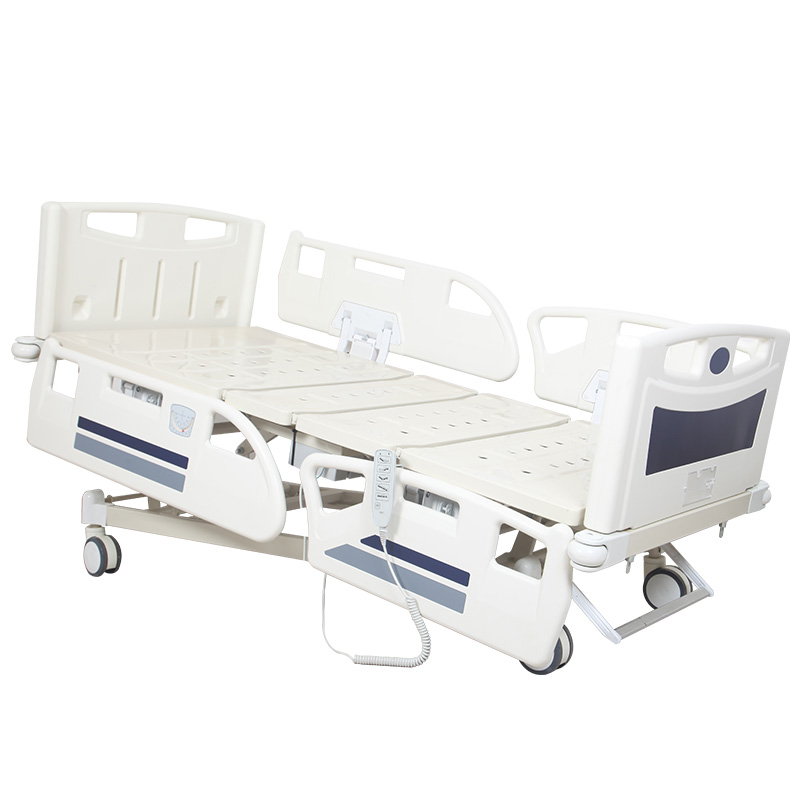
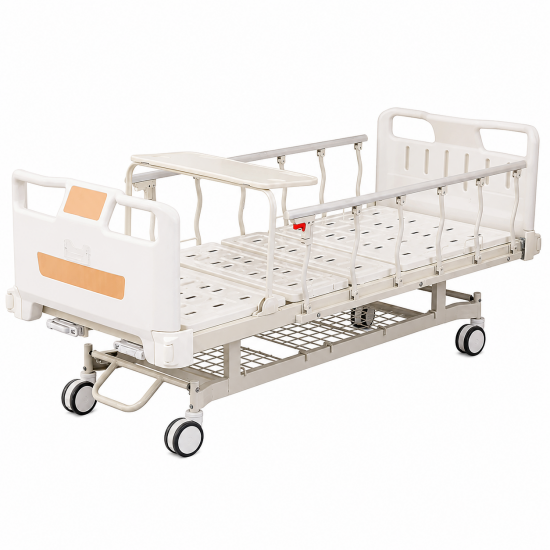
For healthcare facilities that prefer the reliability of mechanical positioning but need more practical features than a conventional manual bed, this model offers a well-balanced solution. The two-crank system provides independent backrest and leg adjustment, while an integrated flip-over table, hydraulic soft-lowering mechanism, long curved folding side rails, central braking system and spacious under-bed storage improve convenience during daily patient care.
The main positioning functions require no electrical power, making this Hospital Bed particularly suitable for hospitals, clinics and medical projects where simple operation, dependable performance and manageable maintenance costs are important purchasing considerations.
Independent Backrest and Leg Adjustment
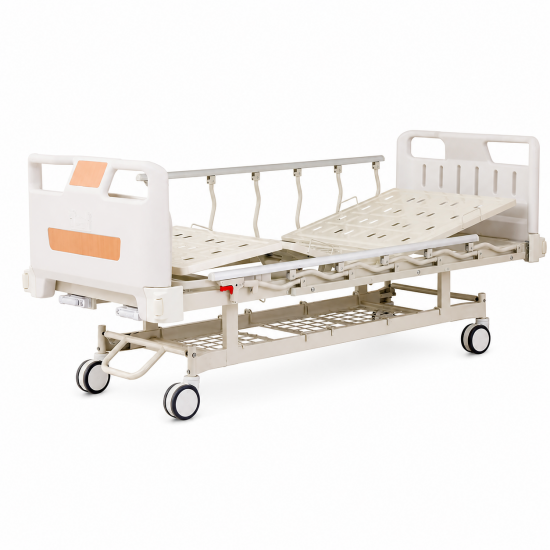
The two manual cranks separately operate the backrest and leg sections. Raising the backrest helps patients move from a flat lying position into a more supportive posture for eating, reading, communication and other bedside activities. The leg section can also be adjusted according to daily positioning requirements.
The mechanical drive system keeps operation straightforward and does not rely on motors, control boxes or an external power supply for these adjustments. This reduces electrical complexity and makes the bed easier to manage in facilities purchasing manual beds for frequent long-term use.
Integrated Flip Table Saves Valuable Bedside Space
Instead of requiring a separate movable overbed table, this model incorporates a flip-over table directly into the bed structure. Caregivers can raise the table when the patient needs a surface for meals, reading or personal items and fold it away toward the foot end when it is no longer required.
This arrangement helps reduce unnecessary equipment around the bed and keeps frequently used patient functions within one compact unit. It is especially practical in wards where available floor space is limited or where beds are positioned relatively close together.
Hydraulic Damping for Smooth Table Lowering
The flip table is supported by a hydraulic damping mechanism that controls its downward movement. When the table is returned to the storage position, it lowers progressively rather than dropping abruptly.
This seemingly small design detail makes a noticeable difference in everyday operation, particularly in environments where caregivers may raise and lower the table several times during a patient's stay.
148 cm Long Curved Folding Side Rails
The side protection system uses extended curved folding rails with an approximate length of 148 cm. Compared with shorter conventional rails, the longer structure provides broader coverage along the side of the mattress platform while retaining convenient folding operation.
The contoured rail design also gives the bed a more distinctive appearance than traditional straight hospital bed rails. When direct access is needed for nursing procedures or patient transfer, the rails can be lowered to open the bedside area.
Central Brake for Faster Bed Positioning
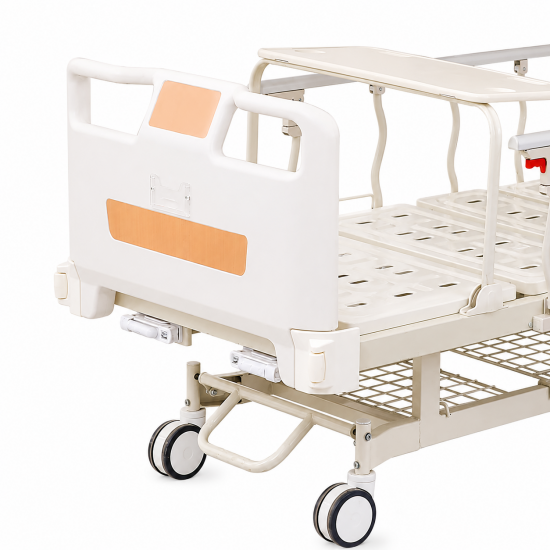
Hospital beds are frequently moved for cleaning, room arrangement and nursing procedures. For this reason, the model uses a central braking system rather than relying only on individual caster locks.
Caregivers can secure the bed through the centralized brake mechanism after repositioning, simplifying routine movement and helping reduce the number of separate operations required to stabilize the bed.
Large-Capacity Under-Bed Storage Rack
A particularly practical feature is the large metal storage rack positioned beneath the mattress platform. Unlike a small accessory basket, the rack extends across a substantial area of the lower bed frame and provides useful space for storing appropriate patient belongings, nursing supplies and other frequently required items.
Locating the storage area beneath the bed makes better use of available space while helping keep the surrounding floor area organized. For hospitals purchasing beds for multi-bed wards, rehabilitation rooms or long-term patient accommodation, this additional storage capacity can improve everyday room management.
Durable Stamped Steel Bed Platform
The mattress support surface is manufactured from stamped steel sections rather than welded wire mesh. The formed platform provides firm and consistent mattress support, while the ventilation openings allow airflow beneath the mattress.
The steel structure is intended for repeated institutional use and provides a practical surface for routine cleaning and maintenance.
Detachable ABS Head and Foot Boards
ABS head and foot boards provide a clean, professional appearance suitable for medical environments. Their smooth molded surfaces are easy to maintain, while the detachable construction provides additional convenience when access is required during maintenance or specific care procedures.
A Practical Upgrade from a Conventional Two-Crank Bed
Many manual hospital beds provide only basic backrest and leg positioning. This model retains those dependable mechanical functions while adding equipment that patients and caregivers can use throughout the day.
The integrated table reduces dependence on separate bedside furniture, hydraulic damping improves table handling, extended folding rails provide side protection, the central brake simplifies mobility management, and the large under-bed rack creates useful storage without increasing the bed's external footprint.
Suitable for Hospitals, Clinics and Medical Projects
The bed is well suited to general wards, community hospitals, clinics, rehabilitation facilities and healthcare projects requiring manual patient beds with a higher level of standard equipment. Its mechanical positioning system can also be an advantage in markets where simple maintenance and reduced dependence on electrical components are priorities.
Built for Institutional and Distributor Procurement
For medical distributors and project buyers comparing different Hospital Bed configurations, this model provides a useful middle ground between an entry-level manual bed and a more complex electric system. Selected specifications, accessories, packaging and OEM requirements can be discussed according to project quantities and destination-market requirements.