

Three Crank Hospital Bed Designed for Reliable Manual Care
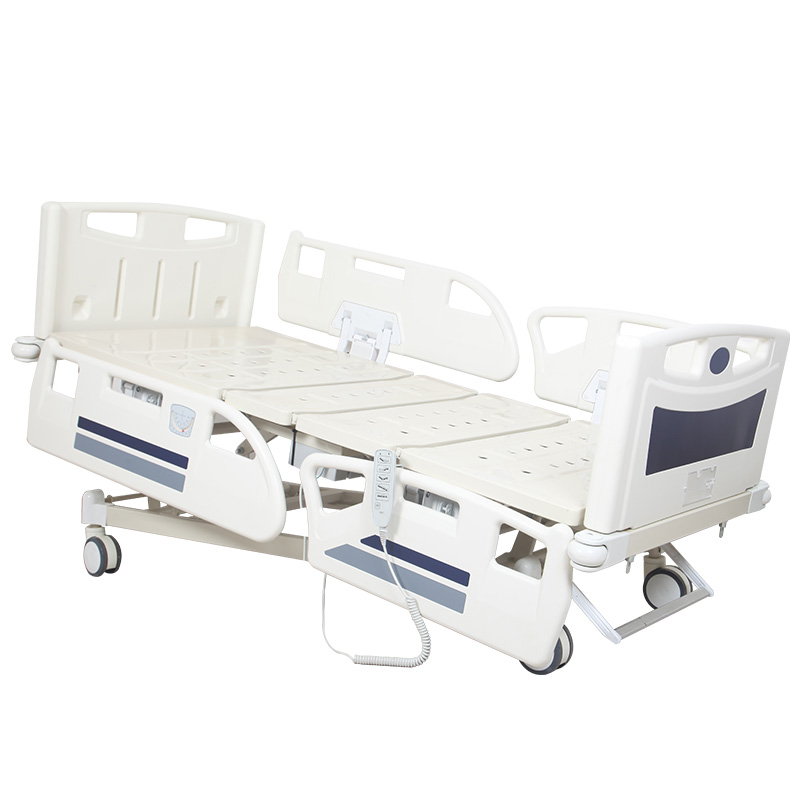
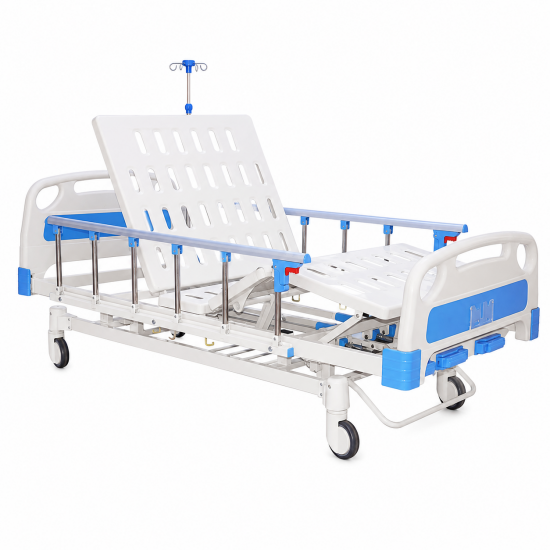
This three crank hospital bed provides hospitals and medical facilities with a practical solution for patient positioning without relying on electric actuators or a continuous power supply. Three independent manual mechanisms control the backrest, leg section and overall bed height, covering the principal adjustments required for routine ward care.
Beyond its three basic positioning functions, this model incorporates several upgrades aimed at improving day-to-day hospital operation. Retractable ABS crank handles, a central locking brake and an under-bed storage rack distinguish it from a conventional entry-level manual bed and make it suitable for facilities seeking greater practicality while retaining a straightforward mechanical system.
Independent Three-Crank Positioning System
Adjustable Backrest for Different Patient Positions
The back section can be manually elevated to change the patient from a flat position to a supported upper-body position. This adjustment is useful during meals, reading, communication and various routine nursing activities.
Manual Leg Section Adjustment
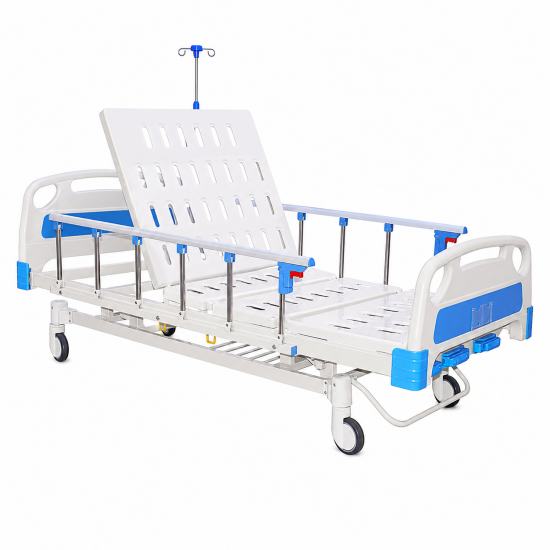
A separate crank controls the leg section, allowing caregivers to modify lower-body positioning according to patient care requirements. The backrest and leg adjustments can be used independently, providing flexibility for different resting and nursing positions.
Manual Height Adjustment
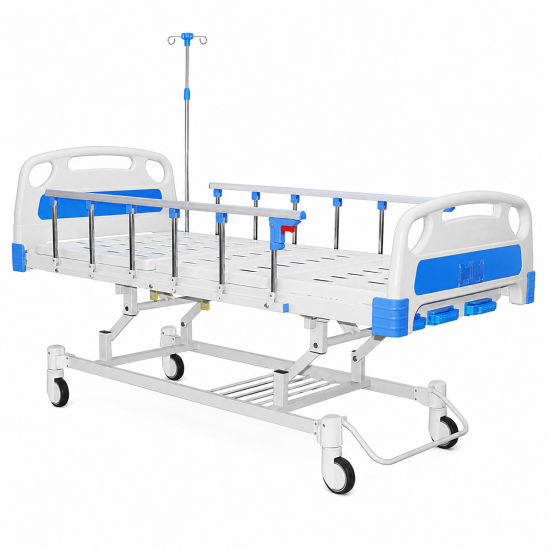
The third crank changes the overall height of the sleeping platform. Height adjustment gives caregivers greater flexibility when preparing the bed for bedside procedures and routine care, while also allowing the platform to be repositioned after nursing activities are completed.
Retractable ABS Crank Handles
Instead of conventional permanently protruding metal handles, this model uses retractable ABS crank handles. Each handle can be pulled out when an adjustment is required and returned to its stored position after use.
The retractable design helps maintain a neater foot-end profile and reduces unnecessary projections around the bed when the adjustment mechanisms are not being operated. This is a useful detail in wards where caregivers, equipment carts and other beds frequently move through limited working spaces.
Central Locking Brake for Ward Mobility
Mobility is an important consideration when hospitals compare manual bed configurations. This model combines medical casters with a central locking brake system, allowing the bed to be secured through a coordinated braking mechanism after it has been moved into position.
The system is particularly practical for wards where beds are periodically repositioned for cleaning, room organization, patient transfer preparation or other clinical activities. Compared with basic independently braked casters, centralized control can simplify routine bed handling for caregivers.
Useful Storage Space Beneath the Bed
An integrated rack beneath the sleeping platform provides a dedicated area for storing lightweight patient belongings or commonly used care items. By utilizing otherwise unused space within the lower bed structure, the rack can help keep the immediate bedside environment better organized.
This feature also creates a clear functional distinction between this model and many basic manual beds designed primarily around positioning functions alone.
Practical Construction for Institutional Environments
Sectional Bed Platform
The articulated sleeping platform works with the three manual adjustment mechanisms to provide stable support throughout different bed positions. Its sectional construction allows the back and leg areas to move independently while maintaining the required support for the mattress.
Protective Side Rail System
Side rails run along both sides of the patient platform to provide additional protection during use. They can be lowered when greater bedside access is needed, helping caregivers balance patient protection with routine nursing requirements.
Hospital-Style Head and Foot Boards
The head and foot sections use molded panels with smooth surfaces suited to regular clinical cleaning. Their practical construction complements the steel bed frame and gives the product the appearance and functionality expected from a general ward medical bed.
Why Choose Manual Adjustment Instead of Electric Operation?
Electric positioning is valuable in many clinical environments, but not every hospital project requires an electrically powered bed. A well-designed manual system can be a practical choice for general wards, clinics and healthcare projects where purchasing cost, straightforward maintenance and independence from electrical power are important considerations.
This model therefore occupies a useful position between basic manual beds and more sophisticated electric systems. Buyers can retain mechanical simplicity while gaining height adjustment, centralized braking, retractable controls and additional bedside storage.
Suitable for Hospitals, Distributors and Medical Projects
The bed can be considered for general wards, clinics, rehabilitation facilities, community healthcare centers and other institutional care environments. It is also suitable for distributors and project buyers looking for a more fully equipped manual Hospital Bed rather than an entry-level two-function or basic three-crank configuration.
Different hospital projects may require changes in accessories, mattress options, packaging or other configurations. Hebei Heyuan Medical Equipment Co., Ltd. supports OEM and ODM requirements for international distributors and project procurement. For product specifications, configuration options and bulk order information, please contact us.