



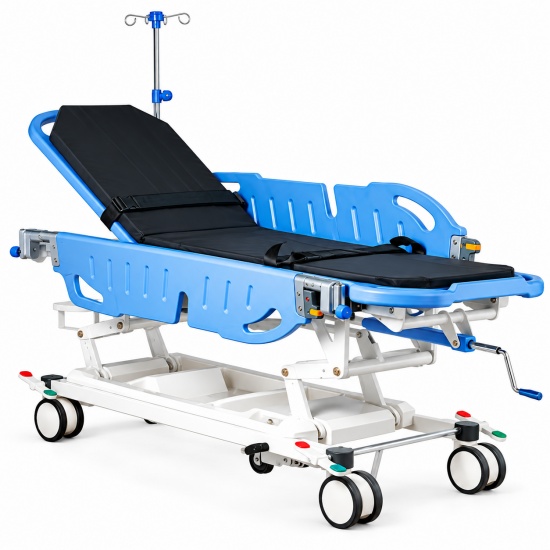
A hospital transport stretcher is used in more situations than simply moving a patient from one department to another. During everyday clinical work, caregivers may need to change the platform height, reposition the patient's upper body, secure the stretcher quickly or gain direct access from either side of the patient. The JH-OCT102 medical transport stretcher combines a 510–850 mm height-adjustable platform, 0–70° gas-spring assisted backrest, central braking system, horizontally folding side rails and 150 mm twin-wheel medical casters. These functions allow the stretcher to adapt to different stages of patient transportation, positioning and temporary clinical care. The patient platform can be adjusted between approximately 510 mm and 850 mm. This wide adjustment range allows the stretcher height to be changed according to the transfer situation and caregiver working requirements. Instead of operating at one fixed height, caregivers can reposition the platform when preparing for patient handling, temporary care or other bedside procedures. Hospital beds, examination equipment and other patient support surfaces may operate at different heights. An adjustable stretcher provides greater flexibility when it needs to be positioned alongside other medical equipment during the patient care process. The back section is supported by a gas-spring mechanism and can be adjusted from a flat 0° position to approximately 70°. Gas-spring assistance supports the back section during adjustment, allowing caregivers to change the patient's upper-body position according to different transport and temporary care requirements. The adjustable backrest allows the same transport platform to accommodate both flat lying and raised upper-body positions. This gives caregivers more flexibility when a patient needs to remain on the stretcher temporarily before, during or after transportation. The JH-OCT102 incorporates a central braking system with foot-operated controls positioned around the stretcher chassis. Once the stretcher reaches the required location, caregivers can operate the braking system without individually locking each caster. This creates a more efficient transition between moving the stretcher and securing it for stationary care. In busy clinical environments, patient transport equipment may move repeatedly between wards, corridors and treatment areas. Convenient foot-operated braking reduces unnecessary handling around individual wheels and supports a more practical daily transport workflow. Four 150 mm twin-wheel resin casters support routine movement through hospital environments. Their twin-wheel configuration provides a stable rolling structure for patient transportation. The caster system works together with the central braking mechanism, allowing the stretcher to alternate efficiently between mobile transport and stationary positioning. The stretcher incorporates protective side rails that can be positioned around the patient during transportation. When closer lateral access is required, the rails can be lowered horizontally. This configuration allows caregivers to approach the patient more directly during transfer, examination, infusion procedures or other short-term clinical care. The side rail system incorporates a safety locking mechanism to secure the protective components in their working position. The design allows caregivers to switch between a protected transport configuration and a more open patient-access configuration according to the procedure being performed. The patient platform and protective components use molded PP construction. The molded surfaces create a clean and practical finish for everyday hospital operation and routine cleaning. The PP components are integrated with the metal stretcher structure to combine patient support, side protection and clinical mobility within one transport system. The stretcher includes an IV pole for infusion support during patient transportation and temporary positioning. For patients who need to continue infusion therapy while moving between departments, the integrated IV pole allows the required equipment to travel together with the stretcher rather than depending on a separate mobile IV stand. A practical medical stretcher should allow caregivers to adapt the equipment as the clinical situation changes. The JH-OCT102 combines three important areas of operation: patient positioning, stretcher mobility and caregiver access. The 510–850 mm adjustable platform and 0–70° gas-spring backrest allow the patient's height and upper-body position to be changed according to the procedure. Four 150 mm twin-wheel casters support movement through the facility, while the central braking system allows the stretcher to be secured after reaching the required location. Horizontally folding side rails allow caregivers to open the side of the platform when closer access is required and restore lateral protection before transportation continues. The stretcher is designed for patient transportation and temporary positioning in hospitals and other professional healthcare environments. Its adjustable configuration makes it suitable for applications where the stretcher needs to move between different clinical areas while providing more positioning flexibility than a basic fixed-height transport trolley. Typical applications can include patient movement between wards, treatment areas, examination areas and other departments where a mobile patient support platform is required. Model: JH-OCT102. Product Type: Adjustable Medical Transport Stretcher / Patient Transfer Stretcher. Overall Size: 1925 × 663 × 510/850 mm. Height Adjustment: 510–850 mm. Backrest Adjustment: 0–70°. Backrest Adjustment System: Gas-spring assisted. Patient Platform: Molded PP construction. Side Rails: Horizontally folding side rails. Side Rail Safety: Integrated safety locking mechanism. Caster Diameter: 150 mm. Caster Configuration: Twin-wheel resin medical casters. Brake System: Central braking system with foot controls. Rated Load Capacity: 300 kg. IV Pole: Included. The JH-OCT102 provides a practical combination of adjustable patient positioning and hospital mobility. Its height adjustment, gas-spring backrest, central braking system and folding side rails make it suitable for healthcare facilities looking for more functionality than a basic transport stretcher. For medical equipment distributors and project buyers, different patient transport products can be selected according to hospital workflow, transfer requirements and required configurations. Explore our Patient Transfer Equipment range for additional hospital stretchers and patient transport solutions. You can also explore our Electric Hospital Beds for additional patient positioning and clinical care equipment. For technical specifications, purchasing quantities, OEM/ODM requirements or quotations, contact us with your project requirements.Adjustable Medical Transport Stretcher for Flexible Clinical Positioning
510–850 mm Height Adjustment Expands Clinical Flexibility
Adjust the Platform for Different Working Conditions
Useful When Working alongside Other Patient Care Equipment
Gas-Spring Assisted Backrest from 0° to 70°
Manual Positioning without an Electric Backrest Actuator
One Stretcher, Multiple Patient Positions
Central Braking System Simplifies Mobility Control
Foot-Operated Brake Controls
Designed for Frequent Hospital Movement
150 mm Twin-Wheel Casters for Smooth Maneuverability
Mobile Chassis Designed for Hospital Corridors
Horizontal Folding Side Rails Improve Patient Access
Protection during Transport, Open Access during Care
Integrated Safety Locking Mechanism
Molded PP Patient Platform and Protective Components
Designed for Routine Hospital Cleaning
Integrated IV Pole Supports Continued Patient Care
Designed around Caregiver Workflow rather than Transport Alone
Positioning
Mobility
Patient Access
Where Can the JH-OCT102 Be Used?
Key Technical Specifications
For Hospitals, Medical Equipment Distributors and Healthcare Projects



