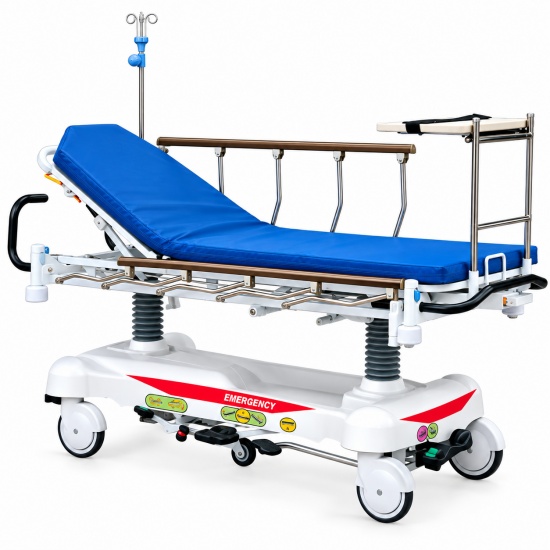
A hospital stretcher often needs to perform several functions during a single patient transfer. Caregivers may need to change the working height, raise the patient's upper body, adjust the knee section, modify the platform angle and then move the stretcher through long corridors or tighter clinical spaces. The JH-PC101 hydraulic hospital stretcher brings these functions together in one patient transport platform. Its positioning system provides 630–930 mm hydraulic height adjustment, 0–85° backrest adjustment, 0–40° knee section adjustment and 0–18° tilt adjustment. A 320 kg safe working load, X-ray translucent HPL platform, retractable central fifth wheel, 200 mm central-locking casters and stainless steel folding side rails further support demanding intra-hospital transportation. The high-low adjustment system uses two hydraulic cylinders to control the patient platform between approximately 630 mm and 930 mm. This allows caregivers to select a suitable platform height according to the patient transfer situation, surrounding equipment and clinical procedure. Different hospital beds and clinical support surfaces may operate at different heights. A hydraulically adjustable stretcher provides greater flexibility when positioning the transport platform beside other patient-care equipment. Height adjustment can also help caregivers select a more appropriate working level when preparing for patient handling or temporary care. The back section uses a gas-spring assisted adjustment system and can be raised from 0° to approximately 85°. This allows the patient to move from a flat lying position to a substantially raised upper-body position without using an electric backrest actuator. The knee section can be adjusted from 0° to approximately 40°. A manual crank is included in the standard configuration for knee section adjustment. This adds another positioning option for patients who remain on the stretcher during transport preparation, temporary observation or other clinical procedures. The patient platform also provides an overall tilt adjustment range of approximately 0–18°. Combined with height, backrest and knee adjustment, this gives the JH-PC101 a broader positioning capability than a conventional fixed-position transport trolley. The JH-PC101 has a specified safe working load of 320 kg. For hospital procurement and clinical equipment planning, SWL should be considered together with the adjustment system, caster configuration, braking mechanism and patient platform construction when selecting a stretcher for frequent use. The patient platform uses HPL construction and measures approximately 1926 × 620 × 6 mm. The material provides a strong, dimensionally stable support surface while allowing X-ray transmission through the platform. X-ray translucency gives the stretcher additional flexibility when imaging access is required as part of the clinical workflow. For hospitals comparing transport stretchers, this feature provides a clear functional difference from conventional metal patient platforms that are not designed for X-ray transmission. The JH-PC101 incorporates an independent retractable central fifth-wheel system. Control pedals are installed on both sides of the stretcher for convenient operation. When engaged, the fifth wheel provides directional guidance to help maintain forward tracking during transportation. This is particularly useful when the stretcher is moved along longer hospital corridors. When the central fifth wheel is raised, the stretcher returns to free caster movement. Caregivers can therefore switch between directional tracking and flexible maneuvering depending on the transport route. This dual-mode mobility is useful when one transfer route includes both long straight corridors and tighter turning areas. The stretcher uses four 200 mm central-locking medical casters. Their large diameter is suited to routine movement through hospital departments and corridors. The central braking system allows all four casters to be secured together through the foot-operated control mechanism rather than requiring individual caster locking. The central brake linkage uses an integrated round-tube structure designed to provide additional structural strength during repeated operation. Four 70 × 80 mm bumper wheels are positioned around the corners of the stretcher to provide additional perimeter protection during everyday maneuvering through clinical environments. The stretcher is equipped with stainless steel folding side rails approximately 1240 mm long. When raised, the side rails extend approximately 430 mm above the patient platform. The rail locking points use zinc die-cast components to provide a strong locking structure for routine patient transportation. When closer access to the patient is required, the side rails can be folded down. This gives caregivers more direct lateral access during transfer and other clinical procedures. An integrated tray is installed beneath the stretcher platform for oxygen cylinder storage and other compatible transport requirements. The tray has a specified load capacity of 20 kg, allowing oxygen support equipment to remain integrated with the patient transport system when required. The standard configuration includes one IV pole and four standard IV pole sockets. A dedicated IV pole storage holder is incorporated into the stretcher so the pole can be secured when it is temporarily not in use. A 1840 × 600 × 80 mm mattress is supplied with the stretcher. Its outer fabric has a water-resistant surface treatment and uses a zippered construction. The external cover can be removed for washing, making the mattress more practical for routine cleaning between uses. Two hydraulic cylinders control the overall 630–930 mm platform height adjustment. Gas springs assist the 0–85° backrest adjustment. A manual crank is provided for the 0–40° knee section adjustment. The retractable fifth wheel provides directional guidance when engaged and allows free maneuvering when retracted. The central braking mechanism controls the four 200 mm casters when the stretcher needs to be secured. Separating these functions clearly helps hospital buyers understand how the JH-PC101 operates rather than simply comparing a list of adjustment angles. Model: JH-PC101. Product Type: Multi-Position Hydraulic Hospital Stretcher. Overall Size: 2140 × 910 × 630–930 mm. Width with Side Rails Raised: 880 mm. Patient Platform Size: 1926 × 620 × 6 mm. Height Adjustment: 630–930 mm. Height Adjustment System: Dual hydraulic cylinders. Backrest Adjustment: 0–85°. Backrest System: Gas-spring assisted. Knee Section Adjustment: 0–40°. Knee Adjustment: Manual crank. Tilt Adjustment: 0–18°. Safe Working Load (SWL): 320 kg. Patient Platform: X-ray translucent HPL. Frame: High-strength steel construction. Side Rails: Stainless steel folding side rails. Side Rail Length: 1240 mm. Side Rail Height Above Platform: 430 mm. Casters: 4 × Ø200 mm central-locking medical casters. Brake System: Central braking system. Directional System: Retractable central fifth wheel. Bumper Wheels: 4 × 70 × 80 mm. Lower Tray: Integrated oxygen cylinder tray, 20 kg load capacity. IV Pole: 1 pc. IV Pole Sockets: 4 standard sockets. Mattress: Water-resistant mattress with removable washable cover. Mattress Size: 1840 × 600 × 80 mm. Optional Accessory: Patient record table / chart table. The JH-PC101 combines patient positioning and transport functions within one hospital stretcher. Hydraulic height adjustment adapts the working level, the gas-spring backrest and adjustable knee section provide multiple patient positions, and the X-ray translucent HPL platform expands its clinical flexibility. For mobility, the combination of 200 mm casters, central braking and a retractable fifth wheel allows caregivers to change between free maneuvering, directional transport and stationary positioning according to the clinical environment. Explore our Patient Transfer Equipment range for additional hydraulic stretchers and hospital transport solutions. You can also explore our Electric Hospital Beds for additional adjustable patient-care equipment. For technical specifications, project quantities, available configurations or OEM/ODM requirements, contact us with your purchasing requirements.Multi-Position Hydraulic Hospital Stretcher for Modern Clinical Transport
Dual Hydraulic Cylinders Control 630–930 mm Height Adjustment
Hydraulic Height Adjustment for Stable Positioning
Adapt the Stretcher instead of Working at One Fixed Height
Four Adjustment Functions on One Transport Platform
0–85° Gas-Spring Assisted Backrest
0–40° Knee Section Adjustment
0–18° Platform Tilt Adjustment
320 kg Safe Working Load for Professional Hospital Use
Designed for Demanding Patient Transfer Applications
X-Ray Translucent HPL Patient Platform
1926 × 620 × 6 mm High-Strength Platform
Designed with Imaging Access in Mind
Retractable Fifth Wheel Changes the Way the Stretcher Maneuvers
Directional Control for Longer Transport Routes
Retract the Wheel for Free Maneuvering
Ø200 mm Casters and Central Braking Work as One Mobility System
Four Large-Diameter Medical Casters
One-Step Central Braking
Four-Corner Bumper Protection
Stainless Steel Folding Side Rails
1240 mm Side Protection with Reinforced Locking Components
Fold-Down Access for Patient Handling
Integrated Oxygen Cylinder Tray for Clinical Transport
20 kg Lower Storage Capacity
IV Pole with Dedicated Storage
Water-Resistant Mattress for Routine Patient Use
Understanding the JH-PC101 Adjustment and Mobility System
Hydraulic System
Gas-Spring System
Manual Adjustment
Directional System
Braking System
Key Technical Specifications
A Hydraulic Transport Platform for Multi-Department Hospital Use