
One Electric Platform for Multiple Rehabilitation Positions
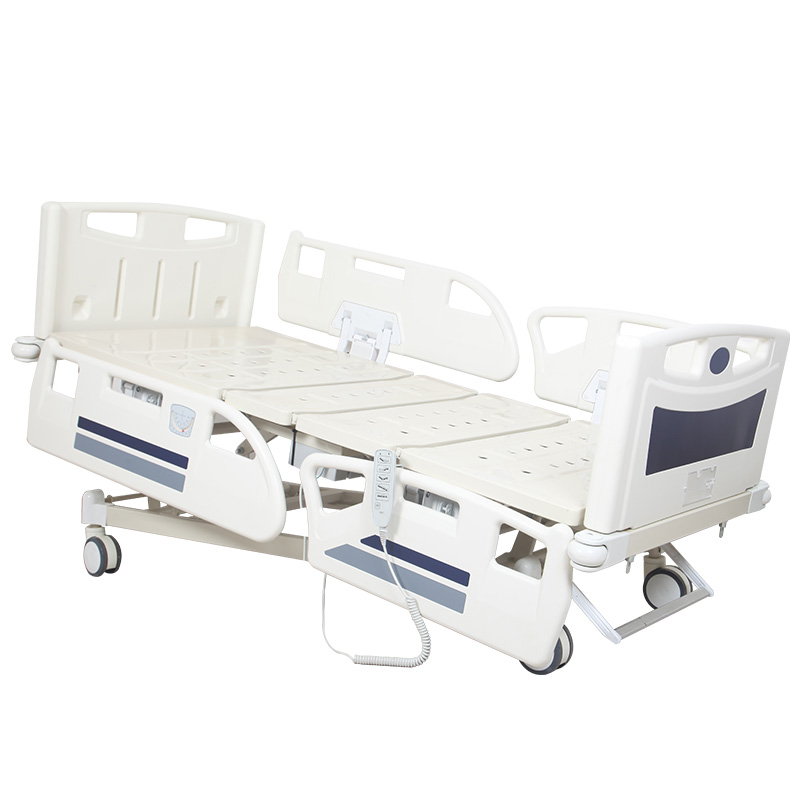
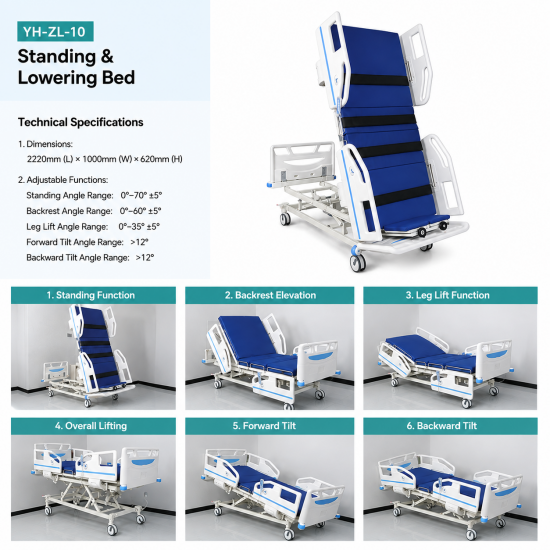
This multi-position electric standing bed is developed for rehabilitation facilities that require more than a conventional tilt-up function. Its electric positioning system combines standing, backrest elevation, leg lift, whole-bed height adjustment, forward tilt and backward tilt on one integrated platform.
Instead of using the bed only for upright training, healthcare professionals can adjust different sections and the complete platform according to different stages of patient positioning and supervised rehabilitation. This makes the model a more versatile solution than basic electric standing beds with a single primary movement.
Six Functions Define This Advanced Configuration
Electric Standing Function
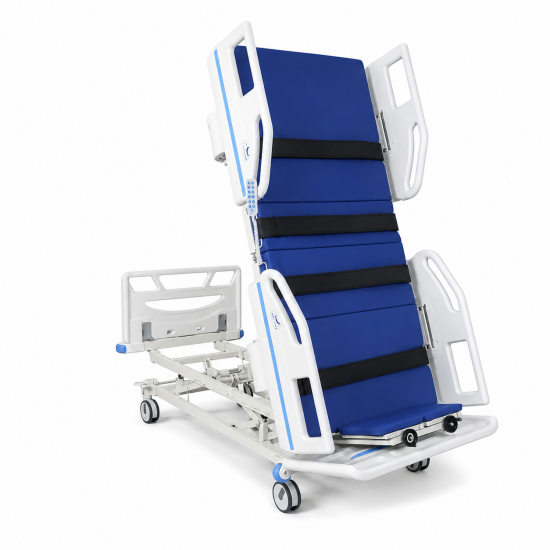
The complete support platform can move progressively from the horizontal position to a standing angle of 0°–70° ±5°. Electric operation allows intermediate angles to be selected during supervised tilt-up and upright positioning.
Progressive Rather Than Fixed-Position Standing
The patient does not need to move directly from lying to the maximum standing angle. The platform can be stopped at different positions within its adjustment range, giving rehabilitation professionals greater control over the positioning process.
Backrest Elevation from 0° to 60° ±5°
The back section can be raised independently when an upper-body position is required without activating the complete standing platform. This provides additional flexibility for supported sitting, routine positioning and care between rehabilitation sessions.
Leg Lift from 0° to 35° ±5°
The electrically adjustable leg section can be elevated independently and can also be used together with the backrest. This expands the available patient positions beyond the primary standing function.
Electric Whole-Bed Lifting Adds Practical Flexibility
Adjust the Complete Platform Instead of Only the Mattress Sections
A key upgrade on this model is electric whole-bed height adjustment. While backrest and leg movements change individual sections of the support surface, the lifting system raises or lowers the complete bed platform.
This provides a more adaptable working position for patient preparation, routine nursing procedures and rehabilitation activities.
Useful for Different Care and Rehabilitation Tasks
A fixed-height standing bed may be sufficient when the equipment is used primarily for tilt-up training. In a multi-purpose rehabilitation environment, however, adjustable platform height can make the same equipment more practical throughout the care workflow.
Forward and Backward Whole-Platform Tilt
Forward Tilt Greater Than 12°
The complete bed platform can be electrically tilted forward by more than 12°. This is a whole-platform movement and is therefore different from simply raising or lowering the backrest.
Backward Tilt Greater Than 12°
The platform can also tilt in the opposite direction by more than 12°, providing bidirectional whole-bed positioning for professional care and rehabilitation applications.
Trendelenburg and Reverse Trendelenburg Type Positioning
These bidirectional platform movements provide Trendelenburg and reverse Trendelenburg type positioning capability, giving professional users additional whole-body positioning options alongside the standing, backrest and leg functions.
Electric Positioning Makes the Functions Work as a System
The value of this model is not simply the number of individual movements. Its advantage comes from the ability to use different electric adjustments according to the required positioning sequence.
Horizontal Care Position
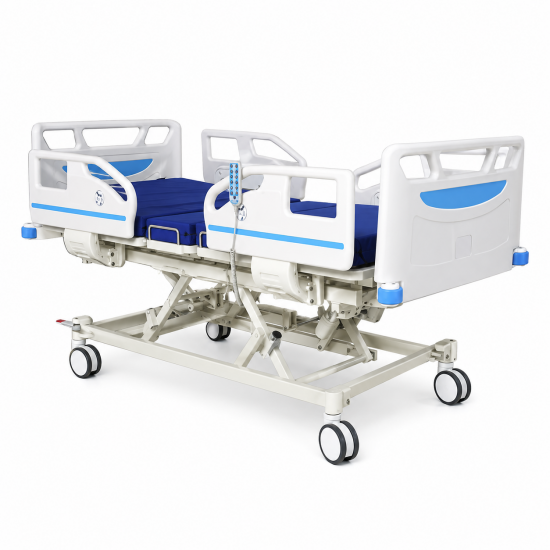
The bed can remain in a conventional horizontal configuration for resting, preparation and routine care.
Supported Upper-Body Position
The backrest can be raised independently when only upper-body elevation is required.
Combined Back and Leg Position
Backrest and leg adjustments can be used together to create additional supported positions without activating the complete standing mechanism.
Height-Adjusted Working Position
The complete bed can be raised or lowered electrically to provide a more appropriate platform height for different care procedures.
Whole-Bed Tilt Position
Forward and backward tilt provide another level of complete-platform positioning beyond individual mattress-section adjustment.
Progressive Standing Position
When upright rehabilitation is required, the complete patient support surface can progressively transition toward the maximum 70° ±5° standing angle.
Designed for Controlled Patient Support During Standing
Multi-Point Patient Support Straps
Several adjustable support straps are positioned across the support surface. They provide additional stabilization at different areas of the body as the platform moves toward an upright position.
Support Throughout the Tilt-Up Process
The straps are particularly important because the relationship between the patient and mattress surface changes as the standing angle increases. Appropriate patient positioning and professional supervision should be maintained throughout operation.
Protective ABS Side Rails
Large ABS side rails provide lateral protection around the patient platform during routine positioning. Their integrated design also gives the bed a cleaner clinical appearance suitable for professional healthcare environments.
Technical Specifications
Overall Dimensions
2220 mm (L) × 1000 mm (W) × 620 mm (H).
Standing Adjustment
Electric Tilt-Up Range
0°–70° ±5°.
Individual Platform Section Adjustment
Backrest Angle
0°–60° ±5°.
Leg Lift Angle
0°–35° ±5°.
Complete Platform Adjustment
Whole-Bed Height Adjustment
Electric lifting and lowering of the complete bed platform.
Forward Tilt
Greater than 12°.
Backward Tilt
Greater than 12°.
Why Choose This Model Instead of a Basic Electric Standing Bed?
A basic Standing Bed is a practical choice when progressive upright positioning is the primary requirement. This model is intended for applications where buyers need standing capability together with a broader range of electrically controlled care positions.
The addition of whole-bed lifting and bidirectional tilt significantly changes the product's positioning flexibility. Combined with independent backrest and leg adjustment, the equipment can support multiple stages of care and rehabilitation rather than serving only as a tilt-up platform.
Suitable for Professional Rehabilitation Environments
Rehabilitation Centers
The multiple electric adjustments make the bed suitable for facilities that perform different positioning procedures as part of structured rehabilitation programs.
Hospital Rehabilitation Departments
For hospital environments, the combination of conventional bed positioning and specialized standing capability allows one platform to address a wider range of patient positioning requirements.
Neurological and Mobility Rehabilitation
The progressive tilt-up design can be incorporated into professionally supervised rehabilitation programs for patients requiring assisted upright positioning.
Long-Term Rehabilitation Facilities
Independent backrest and leg adjustments increase the usefulness of the equipment when the patient is not performing standing activities, making the model more adaptable for extended rehabilitation programs.
A Higher-Specification Electric Standing Bed
For buyers comparing different electric rehabilitation systems, this model should be considered a higher-specification configuration rather than simply another standing bed. Its main advantage is the integration of six positioning capabilities: standing, backrest elevation, leg lift, whole-bed height adjustment, forward tilt and backward tilt.
This combination gives hospitals, rehabilitation centers and medical equipment distributors a more versatile option when basic standing capability alone does not meet the intended application.
View additional rehabilitation configurations in our Standing Bed range. For technical configuration, OEM requirements, purchasing quantities or project quotations, please contact us.