

“Trendelenburg 0–12°” Looks Like a Complete Specification — It Is Not
A hospital buyer receives quotations for several electric five-function beds.
Every supplier lists the same basic functions:
- Backrest adjustment
- Legrest adjustment
- Overall height adjustment
- Trendelenburg
- Reverse Trendelenburg
The technical sheets even show similar tilt figures.
Supplier A states 0–12°.
Supplier B also states 0–12°.
At first glance, the fourth and fifth functions appear identical.
But the angle tells the buyer only where the bed can eventually arrive.
It says much less about how the complete bed gets there, how staff control the movement, what happens to the height of each end, whether cables and accessories remain clear and how stable the bed feels throughout the tilt cycle.
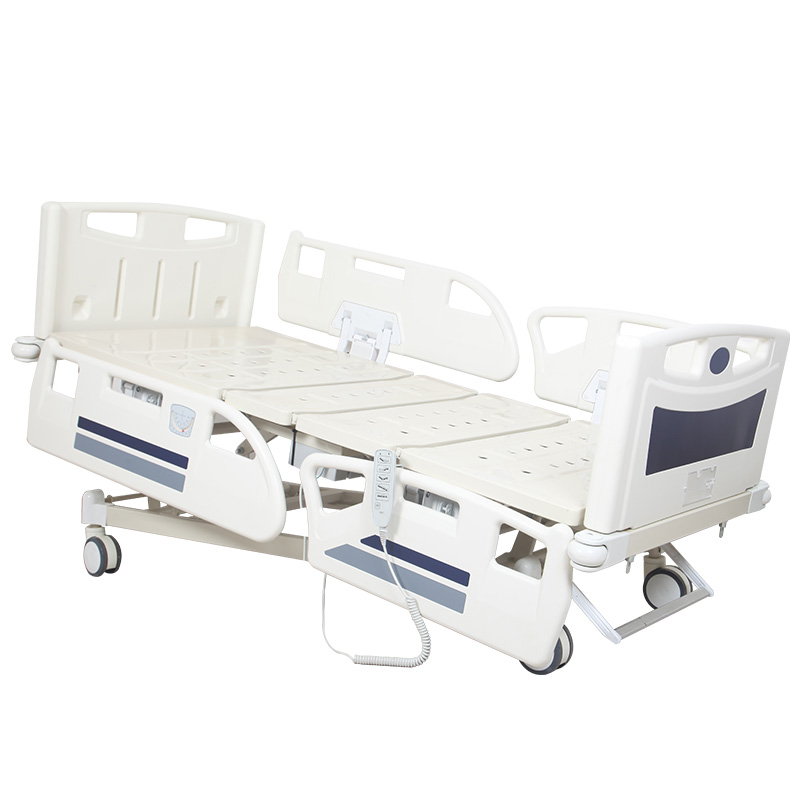
For buyers evaluating an Electric 5-Function Hospital Bed, Trendelenburg should therefore be treated as a complete operating system rather than a single degree value.
First Confirm What the Supplier Is Actually Measuring
Before comparing 10°, 12° or another tilt value, make sure every supplier is using the same reference.
The Mattress Platform Is the Important Reference Surface
A technical drawing should make clear which part of the bed is used to determine the tilt angle.
Buyers should avoid comparing figures taken from different structural reference points.
Ask for a Side-View Technical Drawing
A useful drawing can show:
- Bed in the horizontal position
- Trendelenburg position
- Reverse Trendelenburg position
- Angle reference
- Minimum and maximum bed height
This makes the specification much easier to interpret than a single number in a quotation.
Check Whether the Mattress Platform Tilts as One Complete System
The buyer should understand how the complete platform changes orientation during Trendelenburg and reverse Trendelenburg.
This is different from simply raising the backrest or leg section.
Two Beds Can Reach the Same Angle Through Different Mechanical Movements
The visible result may be 12° on both beds, but the lifting structures underneath can operate differently.
Watch the Head and Foot Ends During Tilt
Depending on the lifting architecture, the bed may change the relative height of its head and foot ends in different ways.
Ask the supplier to demonstrate the movement continuously from horizontal to full tilt.
Do Not Judge the Function From the Final Photograph
A photograph showing the bed at 12° proves only the final position.
It does not reveal:
- Movement smoothness
- Intermediate stability
- Clearance underneath
- Cable behavior
- Control response
Trendelenburg Should Be Tested Through the Complete Movement, Not Only at Maximum Angle
Hospital beds do not normally jump directly from 0° to the maximum tilt.
The actuator system moves through many intermediate positions.
Stop the Bed at Several Angles
During sample evaluation, stop the movement at several points rather than testing only horizontal and maximum tilt.
Observe whether the bed remains controlled and stable throughout the range.
Then Reverse the Direction
Move back toward horizontal and continue into reverse Trendelenburg.
Look for Consistency
The transition between directions should follow the intended control logic without obvious hesitation, interference or abnormal mechanical noise.
Tilt Speed Can Change the User Experience Even When the Final Angle Is the Same
Two beds can have the same maximum Trendelenburg angle but use actuator systems with different operating speeds.
Faster Is Not Automatically Better
The objective is not to make the bed tilt as quickly as possible.
Movement should be appropriate to the product design and intended operation.
Slower Is Not Automatically Better Either
An unnecessarily slow system can make repeated adjustments less convenient.
Evaluate Controlled Movement Rather Than Marketing Speed
Buyers should watch whether the bed starts, moves and stops in a predictable manner.
The Control Method Can Make the Same Trendelenburg Function Feel Completely Different
This is especially relevant on higher-configuration electric beds.
Handset Control
Some models allow Trendelenburg-related functions through a handheld controller according to their control configuration.
Side Rail Controls
Other beds may integrate selected controls into the side rails.
Caregiver or Footboard Control Panel
Higher-specification models may place staff controls at the foot end or in another centralized interface.
Ask Who Is Supposed to Control the Tilt Function
Different hospital projects may require different control permissions.
The supplier should explain which interface operates Trendelenburg and reverse Trendelenburg on the exact quoted model.
Function Lockout Can Matter More Than Another Degree of Tilt
A quotation may focus heavily on whether the bed reaches 10° or 12° while giving very little information about control permissions.
For some projects, the ability to restrict selected movements may be a more meaningful operational requirement.
Ask Whether Trendelenburg Can Be Locked
If the bed includes function lockout, buyers should confirm:
- Which functions can be restricted
- Which control panel manages the restriction
- How the function is restored
Test It on the Sample
Do not assume that a padlock symbol means every movement can be independently restricted.
Height Adjustment and Trendelenburg Should Be Tested Together
A five-function electric hospital bed can normally change both overall height and whole-bed tilt.
These functions interact mechanically.
Test Tilt at Different Bed Heights
During sample inspection, try the agreed operating sequence at:
- A lower bed position
- A normal working height
- A higher bed position
Observe how the lifting system behaves.
Confirm Any Control Restrictions
Some designs may limit certain combinations of movement according to their control logic.
Buyers should understand this before placing a bulk order rather than assuming every function can operate in every possible combination.
The Bed's Lowest Point Can Change During Trendelenburg
Minimum bed height is usually measured with the mattress platform horizontal.
When the bed tilts, one end moves closer to the floor while the other moves higher.
Under-Bed Clearance Should Be Checked During Full Tilt
Look at the relationship between the floor and:
- Lifting structures
- Actuators
- Control box
- Cables
- Caster assemblies
- Other under-bed components
The Horizontal Position Is Not the Only Position That Matters
A component that has generous clearance at 0° may sit differently when the complete platform is tilted.
Cable Routing Becomes More Important on a Five-Function Bed
A simple electric bed already contains moving cables.
Adding whole-bed tilt increases the number of geometries the electrical system must accommodate.
Watch the Cables During Trendelenburg
Ask the supplier to perform the movement slowly enough that the routing remains visible.
Check whether cables:
- Become excessively tight
- Approach moving linkages
- Rub repeatedly against frame components
- Move toward casters
- Become pinched between structures
Then Repeat in Reverse Trendelenburg
The cable path can change in the opposite direction.
A Central Brake Is Separate From Trendelenburg — But It Matters During Tilt Testing
The fourth and fifth functions concern positioning.
The braking system concerns mobility and stability.
They are separate specifications, but they need to work together in the complete product.
Secure the Bed Before Evaluating the Tilt System
The bed should be operated according to the manufacturer's intended procedure.
Check the Brake System Separately
For beds using central braking, buyers can test:
- Pedal operation
- Brake engagement
- Release
- Bed stability after braking
Do Not Assume “5-Function” Includes Central Braking
It should be specified separately in the RFQ.
Side Rails Also Change Their Relationship to the Mattress During Whole-Bed Tilt
Side rail dimensions do not change, but the complete bed orientation does.
Evaluate the Rail With the Mattress Installed
The final geometry depends on both the bed and mattress.
Operate the Rails in Different Bed Positions
Depending on the manufacturer's instructions, evaluate rail operation with the bed:
- Horizontal
- At an intermediate height
- In relevant tilted positions
Check Control Panels If They Are Integrated Into the Rails
On higher-specification models, make sure controls remain clearly accessible and securely installed throughout normal bed movement.
Accessories Can Interfere With the Tilt System Even When the Bed Itself Works Correctly
Hospital beds are often supplied with or used alongside accessories.
Install the Intended IV Pole
Check how it behaves when the bed changes orientation.
Check Drainage Hooks and Other Mounted Accessories
Any accessory attached to the frame should remain compatible with the permitted movement range.
Test the Final Configuration, Not the Bare Demonstration Bed
A five-function bed that works perfectly without accessories still needs to be evaluated in the configuration the hospital intends to use.
Wall and Bedside Equipment Clearance Can Change During Tilt
Trendelenburg movement changes the spatial relationship between the bed and the room around it.
Observe the Head and Foot Ends
Check whether the complete bed or attached components approach:
- Wall-mounted equipment
- Bedhead units
- Power cables
- Bedside furniture
- Other equipment
This Matters More in Compact Rooms
A small spatial difference on one sample can become a repeated installation issue across an entire ward.
The Mattress Needs to Follow Whole-Bed Tilt as Part of the Complete System
The mattress is not creating the Trendelenburg angle, but it remains part of the patient-support surface while the bed tilts.
Check Mattress Retention
The mattress should remain appropriately positioned according to the bed design.
Look at Mattress Retainers
Buyers can inspect the structures intended to keep the mattress correctly located during normal bed operation.
Do Not Change Mattress Size Without Rechecking the Complete Bed
An incorrectly sized mattress can affect more than comfort.
It can change the relationship between the mattress, platform, retainers and side rails.
Trendelenburg and Reverse Trendelenburg Should Not Be Treated as Two Independent Marketing Buttons
They are opposite directions of whole-bed tilt within the same structural system.
Compare Both Directions
Do not test Trendelenburg and simply assume reverse Trendelenburg performs identically.
Observe Whether the Maximum Angles Are the Same
If the supplier declares different ranges, the quotation should state them clearly.
Angle Accuracy Should Be Verified Using an Appropriate Measurement Method
For tenders that specify a required tilt range, buyers may want to verify the actual sample.
Use a Suitable Angle-Measuring Tool
Measurement should be made from the appropriate mattress-platform reference surface according to the product design.
Do Not Estimate the Angle From a Photograph
Camera perspective can make an 8°, 10° and 12° tilt look surprisingly similar.
Do Not Accept a Catalog Drawing as Proof of the Production Bed
A supplier's technical drawing is useful for understanding the design.
For bulk purchasing, the physical sample should correspond with the approved specification.
Measure the Sample
Verify the agreed tilt range and other relevant dimensions.
Record the Approved Configuration
Keep:
- Model number
- Technical drawing
- Angle measurements
- Control configuration
- Photos or video of the approved sample
Use the Same Reference During Pre-Shipment Inspection
This helps prevent specification drift between sample approval and bulk production.
Motor Count Still Does Not Tell You How Trendelenburg Is Created
Buyers sometimes assume a five-function bed must use a specific number of motors.
The mechanical relationship between actuators and functions can vary by design.
Ask Which Actuators Control the Height and Tilt System
The supplier should be able to explain the electrical and mechanical architecture of the quoted model.
Focus on the Resulting System, Not Only the Number of Actuators
The important procurement questions are:
- Does it achieve the required movement?
- Is the movement controlled?
- Is the declared range verified?
- Can components be serviced?
Loaded Operation Matters More Than an Empty-Frame Demonstration
An empty bed places less demand on the lifting system than the complete equipment configuration used in service.
Ask How the Manufacturer Verifies the Function Under Its Declared Operating Conditions
Technical documentation is more meaningful than an improvised heavy-load demonstration.
Do Not Exceed the Manufacturer's Declared Limits During Inspection
Procurement testing should follow appropriate procedures rather than attempting unsafe overload demonstrations.
Trendelenburg Should Be Included in Electrical Spare-Parts Planning
If the whole-bed tilt depends on the lifting actuators and control system, future serviceability matters.
Ask Which Components Are Responsible for the Function
Depending on the design, relevant parts can include:
- Actuators
- Control box
- Handset
- Staff control panel
- Cables and connectors
Ask How a Fault Is Diagnosed
If height adjustment still works but Trendelenburg does not, the maintenance team needs a defined troubleshooting path rather than replacing components by trial and error.
A Fault in One Function Should Be Discussed Before the Beds Are Installed
A five-function bed may remain partly operational even if one system requires service.
Ask About Fault Isolation
Can the supplier identify whether the issue is likely related to:
- Control input
- Actuator
- Control box
- Connector
- Mechanical linkage
Good Documentation Reduces Downtime
For a hospital operating many identical beds, component identification and fault guidance can be as important as the original specification.
Do Not Pay for a Larger Tilt Angle Unless the Tender Actually Requires It
One supplier may advertise 12° while another offers 10° or another range.
The largest number is not automatically the best purchasing decision.
Use the Hospital's Defined Requirement
The required clinical functionality should come from the hospital's approved specification and relevant professional requirements.
Do Not Turn Product Comparison Into an Angle Competition
Once the required range is satisfied, control quality, stability, serviceability and the complete bed configuration may become more meaningful differences.
A Better RFQ Should Define Trendelenburg as More Than “Yes”
Instead of writing:
“Trendelenburg: Yes.”
a more useful specification can include:
Movement
- Required Trendelenburg range
- Required reverse Trendelenburg range
- Angle measurement reference
Control
- Authorized control interface
- Function lockout requirement
- Staff control configuration
Electrical System
- Relevant actuator system
- Control box configuration
- Battery requirement where applicable
Bed Configuration
- Required height range
- Side rail configuration
- Caster and central brake system
- Mattress specification
- Accessories
Verification
- Sample function test
- Angle measurement
- Continuous demonstration video
- Random bulk-production testing
This makes supplier quotations much easier to compare.
One Continuous Video Can Reveal Whether Two “12° Beds” Are Really Comparable
For overseas purchasing, ask suppliers to demonstrate the same sequence.
Suggested Test
- Start with the bed horizontal
- Show the control interface
- Move into full Trendelenburg
- Measure or show the declared angle
- Return to horizontal
- Move into reverse Trendelenburg
- Return to horizontal
- Change the bed height
- Repeat the tilt function
- Show the under-bed system
- Show cable movement
- Show central braking
Keep the Camera Wide Enough to Show the Entire Bed
A close-up of the control buttons proves very little about the actual movement geometry.
Random Bulk Inspection Should Include the Fourth and Fifth Functions
Pre-shipment testing often focuses on backrest and legrest because those movements are easy to observe.
Trendelenburg functions should not be forgotten simply because they are used less frequently during factory demonstrations.
Select Beds From Different Parts of the Finished Batch
Test:
- Trendelenburg
- Reverse Trendelenburg
- Height adjustment
- Control response
- Unusual noise
- Cable routing
Compare Against the Approved Sample
The goal is to confirm that the complete five-function system, not only the first three movements, matches the purchase specification.
The Angle Is Only the Endpoint — The Product Quality Is in Everything That Happens Before the Bed Reaches It
Trendelenburg and reverse Trendelenburg are important defining functions of many electric five-function hospital beds.
But two beds that both state “0–12°” should not automatically be treated as technically equivalent.
The actual purchasing comparison includes:
- How the angle is defined
- How the platform moves
- How staff control the movement
- How the height system interacts with tilt
- How stable the bed remains
- How cables and accessories behave
- How the function can be serviced
This leads to a useful procurement principle:
Do not compare Trendelenburg hospital beds only by maximum degrees. Compare the complete electric and mechanical system that creates those degrees.
That is where two apparently identical five-function hospital beds can begin to look very different.
Hebei Heyuan Medical Equipment Co., Ltd. manufactures electric hospital beds in three-function, five-function and ICU-oriented configurations for hospital projects and medical equipment distributors.
Buyers can explore our Electric Hospital Bed range to compare different powered positioning and control configurations.
For hospital tenders, distributor purchasing or customized five-function hospital bed requirements, please contact us with the required quantity, tilt range, control configuration and project specifications.