

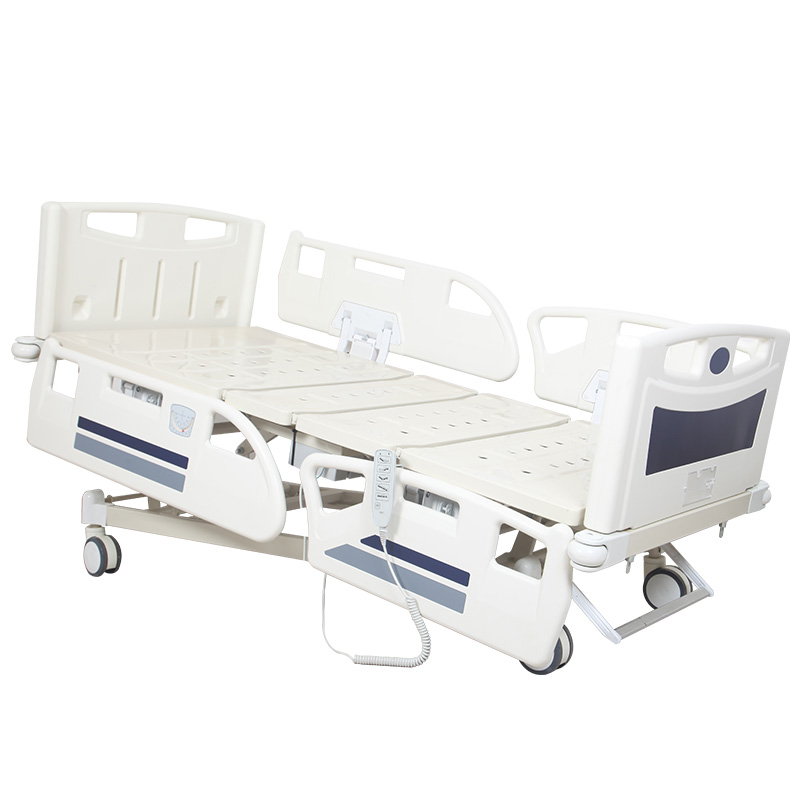
When buyers compare electric hospital beds, they often see specifications such as backrest adjustment, leg adjustment, height adjustment, Trendelenburg, and reverse Trendelenburg. The first three functions are relatively easy to understand. Trendelenburg terminology can be less obvious, especially for distributors, new healthcare project buyers, or procurement teams comparing hospital beds from several manufacturers. Understanding these positions is important because they are among the main features that distinguish many three-function electric beds from more advanced five-function configurations. However, buyers should also understand that the presence of a Trendelenburg function does not automatically mean a bed is suitable for every clinical application. Intended use and clinical positioning decisions should follow the healthcare facility's professional requirements. Trendelenburg positioning refers to tilting the complete mattress platform so that the head end is lower than the foot end. The entire bed platform tilts as one structure rather than only raising or lowering the backrest. Backrest adjustment changes only the upper section of the mattress platform, while Trendelenburg changes the angle of the complete sleeping surface relative to the floor. You can review different Electric Hospital Bed configurations to compare standard positioning and advanced five-function systems. Reverse Trendelenburg is the opposite tilt direction. In this position, the head end of the complete mattress platform is higher than the foot end. This distinguishes them from backrest or leg adjustment, where only one part of the bed platform moves. A common five-function electric hospital bed usually provides five major positioning movements. Depending on the mechanical design, several functions can be created by coordinated operation of different actuators. This is why buyers should evaluate the actual movement system rather than assuming the number of motors must equal the number of functions. Advanced electric beds commonly use separate lifting mechanisms positioned at different areas of the bed base. The lifting mechanisms move together so that the complete platform rises or lowers while remaining approximately level. The head and foot sections move to different heights, creating an inclined platform. The relative height difference is reversed. The final tilt angle depends not only on actuator stroke but also on the design of the lifting structure and connection geometry. This is one of the most common specification misunderstandings. Raises or lowers the complete bed while keeping the mattress platform approximately level. Tilts the complete platform so the head and foot ends are at different heights. A quotation describing “electric lifting and tilting” may not clearly show how each function operates. A short operation video is often the easiest way to verify the difference. Another common mistake is treating a raised backrest as the same thing as reverse Trendelenburg. Only the upper mattress platform section rises. The complete mattress platform remains relatively flat while the entire bed tilts with the head end higher. Buyers should not accept a quotation that substitutes one movement for the other when the tender specifically requires reverse Trendelenburg. A three-function electric hospital bed usually focuses on the movements required most frequently in general patient care. Not every healthcare environment requires full-bed tilt. For general wards, rehabilitation environments, or other applications, a three-function configuration may provide a simpler and more economical solution depending on facility requirements. A five-function configuration may be more appropriate when the healthcare project specifically requires full-bed tilt in addition to basic patient positioning. The correct configuration should match actual clinical and operational requirements. Buyers often see different angle specifications from different manufacturers. One bed may provide one tilt range while another uses a different mechanical geometry. The required range should be determined by the intended application and project specification rather than simply selecting the highest available number. Two suppliers may state different Trendelenburg angles even if the real difference is smaller than expected because they use different measurement methods. For important tender specifications, buyers can request photographic or video evidence showing the bed at the required tilt with the measurement method visible. The answer depends on the bed's mechanical and control design. Some systems may permit full tilt through a broad height range, while others may have operating limitations. A function listed on the specification sheet should also be evaluated in the positions where the hospital expects to use it. Tilting a hospital bed changes the relationship between the mattress platform, headboard, footboard, walls, and nearby equipment. A bed may fit perfectly in its neutral position but require more practical clearance when tilted. The mattress needs to remain stable and correctly positioned while the bed changes angle. The bed and mattress should be evaluated together during function testing. Side rails remain part of the complete bed system when Trendelenburg functions are used. Testing only the actuator movement without the mattress and rails provides an incomplete picture. Compared with a basic electric bed, a five-function model may require additional control logic and coordinated actuator operation. Healthcare staff should be able to distinguish normal height adjustment from tilt functions without confusion. This depends on the bed design, clinical application, facility policy, and patient condition. Control access should match the intended care environment. Function lockout allows selected movements to be restricted while other comfort adjustments remain available. A patient may be permitted to adjust the backrest while full-bed tilt remains under caregiver control. It also reduces the number of functions a patient needs to understand. Some electric hospital beds provide combined or synchronized movement functions often described as auto-contour. This generally refers to coordinated backrest and leg movement rather than full-bed Trendelenburg tilt. Marketing terminology can differ between manufacturers, so the actual bed movement should always be demonstrated. Advanced beds may provide preset or one-touch positioning buttons. A single button may command several actuators to move together toward a programmed position. Ask whether full-bed tilt is actually required. A well-designed three-function bed may be more appropriate for one project than a more complicated five-function bed. Advanced tilt capability generally requires additional mechanical and electrical complexity compared with a basic electric bed. If one supplier quotes a three-function bed and another quotes a five-function model, the unit prices should not be compared without accounting for the configuration difference. Observe whether movements remain smooth, stable, and consistent throughout the full adjustment range. Unusual vibration, unstable movement, mechanical interference, or inconsistent tilt should be investigated before approving mass production. For international buyers who cannot inspect the sample in person, a continuous video can provide useful information. This also allows buyers to hear motor operation and identify obvious mechanical noise during tilt. Do not simply request a “five-function bed” if the project has specific positioning requirements. The more precisely the movements are defined, the less room there is for suppliers to quote different configurations under the same product name. Learn more about electric bed manufacturing, assembly, and function testing through our Factory page. Trendelenburg and reverse Trendelenburg are useful ways to describe full-bed tilt, but the terminology alone does not tell buyers how well the bed performs. Professional evaluation should consider the actual tilt angle, movement stability, actuator configuration, control system, mattress compatibility, room clearance, and intended healthcare application. The best purchasing decision is therefore not simply “three functions or five functions.” It is to define which positions the facility genuinely needs and then verify that the bed creates those positions correctly. When a supplier offers a five-function electric hospital bed, ask for one continuous video showing all five movements without editing. If Trendelenburg and reverse Trendelenburg cannot be clearly distinguished from normal height and backrest adjustment, request further technical clarification before comparing the quotation. If you are sourcing electric hospital beds for general wards, ICU projects, rehabilitation facilities, or medical equipment distribution, Contact Us to discuss five-function positioning, motor systems, and suitable control configurations.Why Trendelenburg Functions Confuse Hospital Bed Buyers
What Is the Trendelenburg Position on a Hospital Bed?
In Simple Terms:
This Is Different From Backrest Adjustment
What Is Reverse Trendelenburg?
So the Basic Difference Is:
Both Functions Tilt the Whole Platform
Why Do Five-Function Electric Hospital Beds Often Include Both?
These Often Include:
Five Functions Do Not Necessarily Mean Five Motors
How Does an Electric Hospital Bed Create Trendelenburg Tilt?
During Normal Height Adjustment:
During Trendelenburg:
During Reverse Trendelenburg:
Mechanical Geometry Matters
Overall Height Adjustment Is Not the Same as Trendelenburg
Height Adjustment:
Trendelenburg:
Ask Suppliers to Demonstrate Both Functions Separately
Backrest Elevation Is Also Not Reverse Trendelenburg
Backrest Elevation:
Reverse Trendelenburg:
These Positions Feel and Function Differently
Why Do Some Hospital Beds Have Only Three Functions?
Typical Three Functions Include:
This Configuration Can Be Sufficient for Many Applications
When Does a Five-Function Bed Make More Sense?
Buyers May Consider Five Functions When:
Do Not Buy Functions Only Because They Sound More Advanced
How Much Trendelenburg Angle Does a Hospital Bed Need?
Before Comparing Angles, Confirm:
A Larger Angle Is Not Automatically Better
Why Buyers Should Ask How the Angle Is Measured
A Better Comparison Requires:
Ask for a Photo With an Angle Measuring Tool
Should Trendelenburg Work at Every Bed Height?
Ask the Supplier:
Operational Limits Should Be Understood Before Purchase
How Does Trendelenburg Affect the Bed Footprint?
Check Clearance Around:
Room Planning Should Include the Full Movement Range
Mattress Compatibility Matters During Full-Bed Tilt
Buyers Should Check:
A Mattress That Moves Can Reduce Usability
Side Rails Should Also Be Tested During Tilt
During Testing, Observe:
Advanced Bed Functions Should Be Tested as a Complete System
Does Trendelenburg Require a More Complex Control System?
The Electrical System Can Include:
Controller Layout Should Be Clear
Should Patients Be Able to Control Trendelenburg Themselves?
Some Advanced Beds May Provide:
Not Every Function Needs to Be Available to Every User
Why Function Lockout Can Be Useful
For Example:
This Can Simplify Operation
What Is Auto-Contour and Is It Related to Trendelenburg?
Do Not Confuse:
Ask Suppliers to Define Every Preset Function
What Is One-Touch Positioning?
Depending on the Model, Presets May Include:
A Preset Is Different From an Individual Motor Control
How Should Buyers Compare a Three-Function and Five-Function Bed?
Compare Clinical Requirements First
Then Compare:
Do Not Compare Only the Number of Functions
Trendelenburg Functions Can Affect Hospital Bed Price
Cost Differences Can Come From:
Compare Equivalent Specifications
What Should Buyers Test Before Approving a Five-Function Bed?
Test Each Function Separately:
Then Test Combined Operation
Listen and Watch Carefully
Ask for a Full Operation Video
Request a Video Showing:
Ask for Original Audio
Include Trendelenburg Requirements Clearly in the RFQ
A Better RFQ Can State:
Clear Requirements Produce Better Supplier Comparisons
Questions to Ask an Electric Hospital Bed Supplier
Common Trendelenburg Purchasing Mistakes
Five-Function Electric Hospital Bed Checklist
Understand the Movement Before Paying for the Function
Expert Tip