

“5-Function” Sounds Like a Complete Specification — But It Is Only the Beginning
A hospital sends the same inquiry to three suppliers.
The requirement appears straightforward:
“Please quote 100 electric 5-function hospital beds.”
Three quotations arrive.
Every supplier describes the product as a 5-function electric hospital bed.
The photographs look similar.
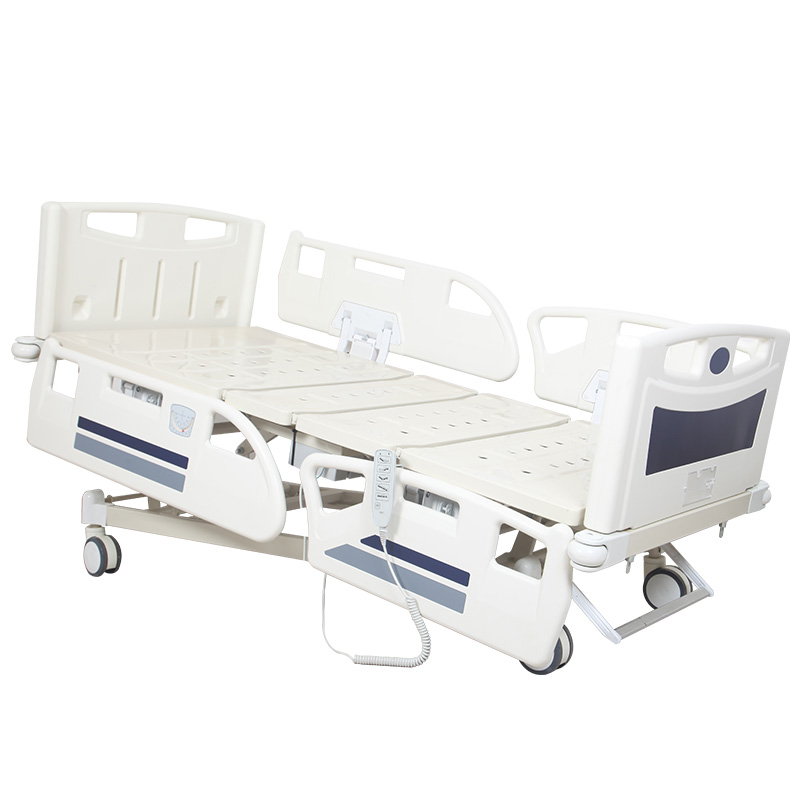
All three beds have electric motors, side rails, head and foot boards and central braking systems.
But the prices are different.
At this point, it is tempting to compare the quotations mainly by price.
That can be a mistake.
For an Electric 5-Function Hospital Bed, the number “5” tells the buyer how many main positioning functions are being counted.
It does not fully describe how those functions operate, how far they move, how they are controlled or what supporting systems are included.
Before comparing prices, procurement teams should first confirm that the suppliers are actually quoting equivalent beds.
What Are the Five Functions Usually Being Counted?
A common five-function electric hospital bed configuration includes:
- Backrest adjustment
- Legrest adjustment
- Overall height adjustment
- Trendelenburg positioning
- Reverse Trendelenburg positioning
This is a useful starting point.
It should not be treated as the complete technical specification.
Function Names Do Not Tell You the Adjustment Range
Two suppliers can both list “backrest adjustment” while offering different maximum angles.
The same applies to leg positioning, overall height and tilt.
Ask for Actual Numerical Ranges
Instead of accepting:
“Backrest: electric.”
Request:
- Backrest adjustment range
- Legrest adjustment range
- Minimum platform height
- Maximum platform height
- Trendelenburg angle
- Reverse Trendelenburg angle
This turns a marketing description into a specification that can actually be compared.
Five Functions Can Be the Same on Paper but Feel Different in Operation
Adjustment range is only one difference.
The way the bed moves can also vary.
Operate the Backrest Through Its Full Range
Watch whether movement is smooth and controlled from the flat position to the maximum intended angle.
Listen for unusual mechanical noise and observe whether the mattress platform moves consistently.
Then Operate the Leg Section
Do not check only the final angle.
Observe the complete movement.
Repeat the Functions Instead of Demonstrating Them Once
A factory demonstration in which each button is pressed once proves only that the function exists.
For sample approval, repeat the main movements several times under the intended test conditions.
Height Adjustment Deserves Its Own Line in the Comparison Sheet
“Electric height adjustment” can hide significant differences between products.
Minimum Height Matters
The lowest position influences the final mattress-top height and how the bed fits the intended care environment.
Maximum Height Matters for Caregiver Access
The upper range affects how the bed can be positioned during bedside activities.
Compare the Range, Not Only One Number
A quotation that lists only “bed height: 500 mm” does not clearly explain whether this is:
- A fixed height
- A minimum height
- A maximum height
- A nominal reference dimension
For an electric bed, ask for the complete minimum-to-maximum range and confirm where the measurement is taken.
Trendelenburg Is Not Just a Checkbox
Trendelenburg and reverse Trendelenburg are usually the fourth and fifth functions that distinguish many five-function beds from simpler configurations.
Yet quotations frequently reduce them to two words.
Ask for the Maximum Tilt Angle
The available range can differ between models.
Watch How the Complete Bed Tilts
During operation, observe:
- Bed stability
- Platform movement
- Clearance around the undercarriage
- Cable movement
- Relationship between the bed and surrounding equipment
Confirm Whether the Function Is Independently Controlled
The control logic should be understood before purchase rather than assumed from the words “Trendelenburg function.”
Control Architecture Can Make Two Five-Function Beds Completely Different Products
This is one of the most important differences hidden behind the same five-function description.
A basic electric bed may use one handheld controller.
Another bed may provide controls integrated into the side rails.
A higher-configuration model may also provide a nurse control panel or footboard control system.
Patient Handset
A handset provides straightforward access to permitted bed movements.
For some wards, this may be sufficient.
Side Rail Controls
Integrated controls can make selected functions accessible from the bedside without relying only on a loose handset.
Nurse or Footboard Control Panel
Depending on the model, a separate staff control interface can provide centralized access to functions and additional control options.
Do Not Compare These Beds as If the Control Systems Were Identical
The five main movements may be the same, while the user experience and electrical architecture are significantly different.
Control Permissions Matter as Much as the Number of Buttons
More buttons do not automatically mean a better electric hospital bed.
The important question is:
Who is allowed to operate which movement?
Patient-Accessible Functions
Depending on the intended use, selected movements may be available to the patient.
Caregiver-Controlled Functions
Other functions may be intended primarily for trained staff.
Ask Whether Selected Functions Can Be Restricted
If the product includes a control-locking or function-restriction system, buyers should understand exactly how it operates and which functions it affects.
This should be demonstrated on the actual quoted configuration.
CPR Is Not Automatically One of the Five Functions
This is a common source of confusion in quotations.
A supplier may describe a bed as “5-function with CPR.”
Another may simply write “5-function ICU bed.”
The buyer should not assume both include the same emergency features.
Five Positioning Functions and CPR Are Different Specification Categories
The five functions normally describe the main adjustable bed positions.
CPR capability is an additional operational feature.
Ask Exactly How CPR Is Activated
Depending on the bed configuration, emergency backrest lowering may use a manual release or another designed control method.
Buyers should request a demonstration rather than relying only on the letters “CPR” in a quotation.
Manual CPR Can Be Different From Electric Positioning
An electric hospital bed uses powered actuators during normal adjustment.
Emergency operation may follow a different mechanism.
Ask the Supplier to Demonstrate the Actual Procedure
During sample approval, observe:
- Where the CPR release is located
- Whether it can be accessed from the intended side
- Which section of the bed is released
- How the backrest behaves during activation
- How the bed is returned to normal operation
Do Not Assume “Dual-Side CPR” Unless It Is Specified
If access from both sides is required, write that requirement clearly into the purchase specification.
Emergency Stop Is Another Feature Outside the Basic Five Functions
Some higher-configuration electric hospital beds include an emergency stop or electrical isolation function.
This should not be assumed simply because the product is called a five-function bed.
Ask Where the Emergency Control Is Located
It should be identifiable and accessible according to the intended design.
Ask What the Control Actually Does
The buyer should understand the manufacturer's specified behavior rather than interpreting the label independently.
Record the Feature Separately in the RFQ
If emergency stop is required, list it as an explicit requirement rather than hiding it under “5 functions.”
The Number of Motors Is Not Always the Same as the Number of Functions
Another common purchasing mistake is assuming:
“Five functions must mean five motors.”
Function count and actuator count are not necessarily the same thing.
One Mechanical System Can Contribute to More Than One Positioning Result
The final bed geometry depends on how actuators, lifting structures and linkages work together.
Ask for the Electrical Configuration Separately
Useful information can include:
- Number of actuators
- Control box configuration
- Handset type
- Additional control panels
- Power supply requirements
- Battery configuration where applicable
This gives the buyer a clearer picture of the electric system than the phrase “5-function” alone.
Motor Brand Is Useful Information — But It Is Not the Whole Electrical System
Buyers sometimes compare electric beds primarily by actuator brand.
Component sourcing matters, but a hospital bed is a complete electrical and mechanical system.
Look Beyond the Motor Label
Consider:
- Actuators
- Control box
- Hand controls
- Wiring
- Connectors
- Cable routing
- Power supply
Installation Quality Matters Too
A reputable electrical component can still be poorly integrated if cables are inadequately routed or connectors are exposed to inappropriate mechanical stress.
Check the Cables While Every Function Is Moving
Electrical cables are easy to ignore when the bed is stationary.
A five-function bed changes geometry repeatedly.
Raise the Bed Fully
Watch whether cables remain appropriately routed through the height range.
Operate Trendelenburg and Reverse Trendelenburg
Observe cable movement as the undercarriage changes position.
Raise the Backrest and Legrest
Check that wiring does not become excessively stretched, pinched or trapped around moving components.
Inspect the Bed in Its Most Extreme Positions
Some cable-routing problems may not appear while the bed remains in a neutral position.
Battery Backup Should Never Be Assumed
An electric hospital bed needs power for normal powered adjustment.
Some configurations may include battery backup, while others may not.
Ask Whether a Battery Is Included in the Quoted Price
If yes, clarify its intended purpose and manufacturer's operating guidance.
Do Not Treat Battery Backup as Unlimited Operation During an Outage
Battery capability depends on the specific system and condition of the battery.
Facilities should follow the manufacturer's charging, maintenance and replacement instructions.
Side Rail Controls Can Change the Side Rail Specification Itself
Two beds may use visually similar four-section side rails.
One may contain integrated controls while the other does not.
This Changes More Than Appearance
Integrated controls introduce:
- Electrical connections
- Control interfaces
- Additional components
- Different replacement-part requirements
Ask for the Exact Side Rail Version
When approving a sample, record whether the quoted bed uses conventional rails or rails with integrated controls.
Do not rely only on a general description such as “ABS side rails.”
A Footboard Control Panel Can Also Change the Quotation Significantly
Some electric medical beds integrate staff controls into the foot-end structure.
Others use a separate panel or only a handset.
Ask What Information or Controls the Panel Provides
Depending on the configuration, functions may differ considerably.
The supplier should demonstrate the actual panel included with the quoted model.
Do Not Compare a Basic Footboard With a Control-Integrated Footboard Only by Appearance
They may look similar in catalog photographs while representing very different electrical configurations.
Central Braking Is Not One of the Five Functions Either
Another specification frequently associated with higher-end electric beds is a central braking system.
Again, it is not normally part of the five positioning functions.
Separate Positioning From Mobility
The five functions describe bed positioning.
Casters and braking determine how the bed moves and is secured.
Quote Them as Separate Specification Lines
For example:
- 5 electric positioning functions
- Central braking caster system
- Specified caster diameter
This makes quotation comparison much clearer.
“ICU Hospital Bed” and “5-Function Hospital Bed” Should Not Be Used as Perfect Synonyms
Many ICU beds use five-function electric positioning.
But the term ICU hospital bed often implies a broader equipment configuration than the number of positioning functions alone.
An ICU-Oriented Configuration May Also Include
- More advanced control architecture
- Emergency operation features
- Integrated staff controls
- Central braking
- Additional accessory mounting
- Other project-specific features
Define the Required Features Instead of Purchasing the Label
If a tender requires an ICU Hospital Bed, procurement teams should still list the actual technical requirements rather than assuming every supplier interprets “ICU” identically.
Two Five-Function Beds Can Also Have Very Different Minimum and Maximum Heights
Both products technically provide electric height adjustment.
That does not mean their lifting ranges are equivalent.
Compare the Complete Range
Ask each supplier to state:
- Minimum platform height
- Maximum platform height
- Measurement reference point
- Mattress thickness used in any mattress-top measurement
Do Not Mix Platform Height and Mattress-Top Height in One Comparison
Use the same measurement method across all quotations.
Safe Working Load Should Be Compared Separately From the Function Count
Five functions tell the buyer how the bed can move.
They do not define how the complete structure is rated.
Ask for the Declared Safe Working Load
Compare this together with the manufacturer's documentation and intended application.
Do Not Infer Capacity From Appearance
Two electric beds with similar dimensions can use different frame structures, lifting mechanisms and component specifications.
The Lowest Quote May Simply Contain Fewer “Hidden” Features
Suppose Supplier A quotes USD X and Supplier B is significantly more expensive.
Both quotations say:
“Electric 5-function hospital bed.”
The price difference may come from more than margin.
Supplier A May Include
- Basic handset control
- Standard side rails
- No battery backup
- No additional staff control panel
- Basic emergency configuration
Supplier B May Include
- Side rail controls
- Staff control interface
- Additional emergency features
- Battery backup
- Different braking configuration
This example does not mean the more expensive bed is automatically better.
It means the buyer must normalize the specifications before comparing price.
Create a “Function + System” Comparison Sheet
Instead of comparing suppliers with one line called “5 Functions,” divide the specification into two groups.
Group 1: Positioning Functions
- Backrest range
- Legrest range
- Height range
- Trendelenburg range
- Reverse Trendelenburg range
Group 2: Supporting Systems
- Control method
- Patient controls
- Staff controls
- Function locking
- CPR configuration
- Emergency stop where required
- Battery backup
- Central braking
- Caster specification
- Electrical component configuration
This Prevents False Price Comparisons
Only after these items are aligned does the quotation become meaningfully comparable.
Ask for One Continuous Function Demonstration Video
For international buyers who cannot immediately inspect the bed in person, video can help verify the actual configuration.
Do Not Request Five Separate Short Clips
A more useful video shows one bed continuously while the supplier demonstrates:
- Backrest
- Legrest
- Minimum height
- Maximum height
- Trendelenburg
- Reverse Trendelenburg
- Patient controls
- Staff controls
- CPR where included
- Emergency stop where included
- Brake operation
Include the Control Panel in the Frame
This allows the buyer to see which button is being operated and what movement follows.
Sample Approval Should Freeze the Electrical Configuration
A buyer may approve the external appearance of a sample but leave the electrical specification too general.
That creates risk during bulk production.
Record the Approved Configuration
Depending on the project, records can include:
- Bed model
- Actuator configuration
- Control box
- Handset
- Side rail control version
- Staff control panel
- Battery configuration
- CPR system
- Emergency stop system
Photograph the Components That Will Be Hidden Later
Some electrical components sit underneath the mattress platform and are difficult to identify once the bed is fully prepared for use.
Reference photographs can support later production verification.
For Bulk Orders, Test the Same Functions on Random Production Beds
A perfect pre-production sample does not automatically prove that every production unit matches it.
Randomly Select Finished Beds
Operate all five functions and verify the additional agreed systems.
Check More Than Movement
Also inspect:
- Control response
- Unusual noise
- Cable routing
- Connector installation
- Control labels
- Emergency features
- Brake operation
Compare Against the Approved Sample and Specification
The objective is not merely to confirm that the bed powers on.
It is to confirm that the product being shipped is the configuration that was purchased.
A Better RFQ Should Never Say Only “Electric 5-Function Hospital Bed”
For serious procurement, that phrase should be the heading of the specification, not the entire specification.
Positioning
- Backrest range
- Legrest range
- Minimum and maximum height
- Trendelenburg range
- Reverse Trendelenburg range
Electrical System
- Actuator configuration
- Control box
- Power requirements
- Battery requirement
- Cable and connector configuration
Controls
- Patient handset
- Side rail controls where required
- Nurse or footboard control
- Function locking where required
Emergency Features
- CPR requirement
- CPR access location
- Emergency stop requirement
Mobility
- Caster specification
- Central braking requirement
Verification
- Function demonstration video
- Sample approval
- Bulk production inspection
This gives suppliers much less room to interpret the words “5-function” differently.
The Number Five Helps You Find the Product Category — It Does Not Tell You Exactly What You Are Buying
An electric five-function hospital bed is one of the most common configurations used when hospitals require backrest, legrest, height and tilt positioning.
But the function count is only the first layer of the specification.
Two beds can both legitimately be described as five-function models while differing in adjustment ranges, control architecture, emergency systems, electrical components, battery configuration, side rail controls and braking systems.
That leads to one simple procurement rule:
Never compare the price of two 5-function hospital beds until you have confirmed that the functions, adjustment ranges and supporting systems are actually equivalent.
Sometimes the cheaper quotation is genuinely better value.
Sometimes it is simply a different configuration hiding behind the same product name.
Hebei Heyuan Medical Equipment Co., Ltd. manufactures electric hospital beds for general wards, ICU applications, distributors and hospital projects, with different control and functional configurations available according to project requirements.
Buyers can explore our Electric Hospital Bed range to compare different medical bed configurations.
For hospital tenders, distributor purchasing or customized electric five-function bed requirements, please contact us with the required quantity, functions, control system and destination market.