

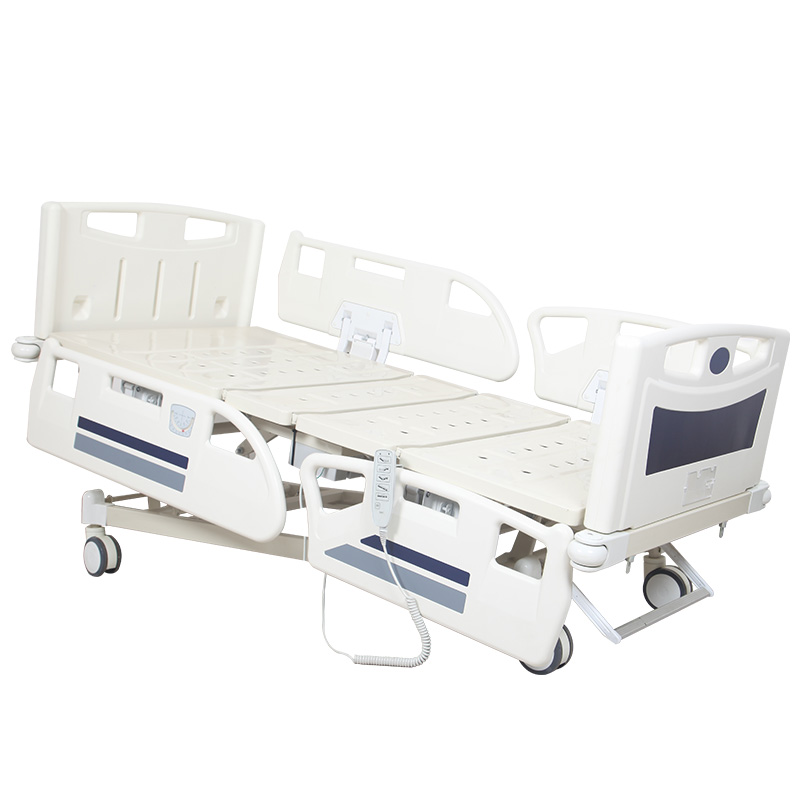
Electric hospital beds are often compared by counting functions. Backrest, knee adjustment, height, Trendelenburg and reverse Trendelenburg are easy to list, but a function list does not show how the bed will perform after thousands of movements, cleaning cycles and room transfers. For buyers, the real difference between electric hospital bed manufacturers lies in engineering discipline: how the frame, actuators, control box, handset, cables, rails and castors work together.
A dependable electric care bed should move smoothly, stop predictably, protect its electrical components and remain understandable to nurses and service teams. These qualities are created during design and verified during production. This guide gives distributors and healthcare project buyers a practical framework for evaluating an electric hospital bed manufacturer.
Electric Adjustment Is a System
An actuator does not operate in isolation. It transfers force through brackets and pivot points into the bed platform. The changing geometry must remain stable across the full movement range, while cables avoid moving joints and the mattress stays supported.
When one part changes, other parts may also need review. A longer actuator can alter angle or travel. A different castor can change minimum height. A new rail can affect access to the handset. A thicker mattress can change the effective height of the rail above the sleep surface.
Professional electric hospital bed manufacturers evaluate the bed as a complete system. Buyers should request a demonstration of every function in sequence, including combinations that may occur during daily care.
Core Functions and Their Practical Value
Backrest adjustment
Backrest elevation supports sitting, eating, communication and many nursing tasks. Buyers should observe whether movement is smooth, whether the mattress follows the platform and whether the final angle matches the approved specification. The user should not encounter exposed pinch areas during normal operation.
Knee-section adjustment
Knee elevation supports positioning and can help prevent the user from sliding when the backrest is raised. The platform geometry, mattress flexibility and linkages should be assessed together.
Whole-bed height
Height adjustment can support caregiver working posture and transfers. Minimum and maximum values should be measured with a clearly defined reference point. Buyers should also confirm under-bed clearance for mobile lifts, cleaning equipment and electrical components.
Trendelenburg and reverse Trendelenburg
Tilt functions require stable chassis design and controlled movement. Their use should follow facility policy and the model’s intended use. Buyers should verify how the function is activated, whether staff control is separated from patient control where needed, and what happens during a power interruption.
More functions are not automatically better. The correct model is the one whose functions match the care setting, training level and maintenance capacity.
What to Inspect in the Drive System
Actuators and mounting points
Ask the manufacturer to identify the actuator for each movement and show how it is mounted. Brackets should be aligned, fasteners secured and moving joints protected from interference. During sample testing, listen for irregular noise and watch for sudden changes in speed.
Control box
The control box connects power, actuators, handset and optional battery components. Its location should balance protection with service access. It should not be placed where routine cleaning, impacts or moving mechanisms create unnecessary risk.
The site’s technical guide on control box placement provides a useful inspection perspective: buyers should photograph the underside and watch the cable layout at both minimum and maximum bed positions.
Handset and controls
Clear icons, a natural button sequence and a reliable hook can reduce confusion. The cable should reach normal user positions without hanging on the floor or becoming trapped by a rail. Staff lockouts or patient controls should be specified according to the intended environment.
For export programs, confirm language, icon artwork and spare-handset compatibility before production. The handset labeling guide explains why these small details affect after-sales performance.
Cables and strain relief
Cables should have controlled loops and sufficient movement allowance. They should not cross sharp edges, rub against pivots, become taut at the end of travel or rest where cleaning tools can catch them. A full-range video is more informative than a single underside photo.
Power and battery options
Confirm input voltage, frequency, plug and grounding requirements for the destination market. If backup power is offered, clarify what it is designed to support, how it is tested and how it should be maintained. Do not assume that every battery option provides the same functions or duration.
Mechanical Safety Still Comes First
An electric bed is also a mobile mechanical device. The frame, rails, castors, brakes, headboards and platform require the same attention as the electronics.
Check rail locks from both sides, including access when the backrest is elevated. Operate brakes on the actual floor surface if possible. Push the bed from different points and observe steering. Look at frame stability at maximum height and during tilt. Confirm that cables remain protected while the bed is moved.
The mattress must be part of the review. Its width, length and thickness influence gaps, rail height and articulation. Approve the bed and mattress combination rather than treating them as unrelated products.
How Manufacturers Should Test Electric Beds
A useful production test is repeatable and recorded. Depending on the model and project, the manufacturer’s inspection plan may include:
- Visual inspection of welds, coating, plastic parts and labels
- Verification of model, voltage, plug and component references
- Operation of every function through its full travel
- Checks for abnormal noise, vibration or interference
- Cable-clearance observation in multiple positions
- Handset button and lockout verification
- Rail lock, castor, brake and steering checks
- Measurement of approved dimensions and angles
- Battery or emergency procedure check where included
- Final accessory and packing-list confirmation
For sample qualification, buyers can add repeated cycling or project-specific checks. The method and acceptance criteria should be agreed before testing so the result is meaningful.
Serviceability Is Part of Product Quality
Electric components will eventually need inspection or replacement. Good design makes this work straightforward without exposing the system to daily damage.
Ask whether connectors are labeled, whether the handset can be replaced without major disassembly, and whether the same actuator or controller is shared across several models. Request an exploded parts view or a clear spare-parts list. For a distributor, a small stock of high-use electrical parts can reduce customer downtime.
Documentation should identify component models accurately. “Motor for bed” is not enough when several actuators look similar. A label, photo, position and compatible bed model make ordering safer.
OEM Customization: Control the Details
Electric bed customization may include handset artwork, plug type, color, rail style, panel design, battery, control layout, branding and packaging. Each change should be approved in a controlled document.
Electrical substitutions deserve particular care. If a different actuator or control box is proposed, confirm compatibility, travel, load assumptions, connectors and documentation. The buyer should understand whether the change affects market requirements or spare-parts planning.
Review electric and home-style nursing bed configurations to identify a suitable base model, then confirm the final details for the project.
Questions to Ask an Electric Hospital Bed Manufacturer
- Which actuator controls each movement, and how are components identified?
- Can you show the cable route at the lowest, highest and tilted positions?
- What inspections are recorded for every finished bed?
- How are handset artwork, voltage and plug controlled by order?
- Which parts are shared across models?
- What is the recommended spare-parts list for the first shipment?
- How are component substitutions approved?
- What instructions are supplied for operation, cleaning and basic service?
- How is the bed packed to protect controls, cables and rails?
- Can the sample inspection checklist become the mass-production standard?
Selecting for Long-Term Value
Price matters, but electrical service calls can quickly consume an initial saving. Compare the complete ownership picture: configuration, inspection, documentation, spare parts, warranty process and communication.
Strong electric hospital bed manufacturers do not rely on a polished demonstration alone. They can show how motion is engineered, how production is controlled and how a distributor or facility will identify parts later.
Heyuan Medical Equipment supplies electric care bed and nursing bed configurations for global customers. To begin a project discussion, share the care environment, required movements, destination power details, quantity and service expectations through electriccarebed.com. A precise brief allows the manufacturer to recommend a practical configuration rather than an unnecessarily complicated one.
Frequently Asked Questions
How many functions should an electric hospital bed have?
The right number depends on the care setting. General positioning may need backrest, knee and height adjustment; other environments may require tilt or staff controls. Select functions from workflow requirements, not from a maximum-feature target.
What should I film during sample inspection?
Record every function from start to finish, the underside cable movement, rail operation, castor steering, brakes, handset use and any battery or emergency procedure. Film the product label and component references as well.
Why is cable routing important?
Poor routing can create tension, abrasion, trapping or cleaning exposure. A bed may work during a short demonstration but develop avoidable faults after repeated movement if the cables are not controlled.
Should spare electrical parts be ordered with the first shipment?
For distributor and institutional programs, a planned starter set is usually sensible. Base it on the supplied models, shared components, expected service level and the manufacturer’s failure-analysis data.
Can electric beds be customized for different markets?
Yes, many elements can be adapted, including plug, voltage, handset artwork, labeling, colors and accessories. Confirm which changes affect documentation, minimum quantities, lead time and applicable destination requirements.